
Low Back Pain & Hip Mobility
Do Tight Hips Cause Low Back Pain? Here's the Honest Answer
You have heard it a hundred times: your tight hips are wrecking your back. The real story is more useful than the soundbite — and it changes what you should actually do about pain that keeps coming back.
Start Here
What the Tight-Hips Soundbite Gets Wrong
If you have spent any time on social media or in a gym, you have probably heard it: "Your tight hips are causing your low back pain." It gets said with total confidence — usually right before someone hands you a stretch and promises it will fix everything.
Here is the honest truth, and it is more useful than the soundbite: the relationship between tight hips and low back pain is real, but it is not as simple — or as one-directional — as it is usually made out to be. Understanding the actual story matters, because it changes what you should do about your back pain, especially if it is the kind that keeps coming back.
At MVMT Rx in Reno and Sparks, we work with active people who are tired of their back pain flaring up every few months — desk workers, lifters, hikers, weekend warriors, and athletes alike. So let us break down what the research actually shows, and what it means for getting you out of the flare-up cycle for good.
The claim "tight hips cause low back pain" is a causal statement. It says one thing — tight hips — directly creates another — back pain. That is a strong claim, and strong claims need strong evidence behind them. When researchers have actually studied this, here is what they found: people with low back pain do tend to have less hip mobility — particularly less hip internal rotation — than people without back pain. So there is a real association.
But here is the part the soundbite skips: an association does not tell us which came first. A 2024 systematic review of 54 studies found that people with low back pain consistently show reduced hip range of motion — especially internal rotation — along with weakness in the hip abductor and extensor muscles.[1] The researchers were careful to point out, though, that these studies can only show a link. They cannot tell us whether stiff hips led to the back pain, or whether the back pain led to the stiff hips, or whether something else entirely caused both. That is not a technicality. It is the whole question.
What the "tight hips cause back pain" claim leaves out: an association is not the same as a cause, reduced hip mobility shows up alongside back pain but may be a result rather than a driver, the strongest finding is reduced hip internal rotation specifically, hip strength deficits (abductors and extensors) often travel with low back pain too, and no single stretch or test can tell you whether your hips are the cause or the casualty.
The Real Question
Which Came First — The Tight Hips or the Back Pain?
Think about it from your own experience. When your back is hurting, do you move more freely, or do you guard, tense up, and avoid certain positions? Almost everyone moves less and stiffens up when they are in pain.
So when we measure someone's hips after they have had back pain for months, and we find their hip mobility is reduced, we genuinely cannot know whether:
- The hips got stiff first and contributed to the back pain, or
- The back pain came first and the hips stiffened up in response, or
- A third factor — a sedentary stretch, a change in training, life stress, poor sleep — drove both at the same time.
This matters because the best available evidence on the link is weaker than the confident soundbite suggests. A separate systematic review looking specifically at whether hip range of motion is associated with nonspecific low back pain concluded that the evidence is very low quality, and that reduced hip internal rotation was the only movement that showed a significant association — a finding the authors said should be viewed with caution.[2] In other words, the confident version of "tight hips cause your back pain" simply is not supported by strong evidence.
Notice what this does not say. It does not say your hips do not matter. It says we cannot honestly claim your tight hips are the cause of your back pain — and any provider who tells you otherwise is selling certainty they do not have. That distinction is the difference between chasing a stretch and building a plan that actually works.
Why "just stretch your hips" rarely fixes recurring back pain: it assumes a cause the evidence does not support, it treats a single structure instead of how your whole body shares load, it does nothing to build strength or tissue tolerance, it ignores the hip strength deficits that often accompany back pain, and it leaves the underlying capacity of your system — the thing that actually keeps pain from returning — completely unchanged.
Looking Deeper
So Should You Just Ignore Your Hips? Not a Chance
This is where a lot of people overcorrect in the other direction. The fact that we cannot prove tight hips cause back pain does not mean your hips are irrelevant. Here is the more accurate way to think about it: your hips are one piece of a bigger system.
How your hips, pelvis, and low back share load during movement matters. Giving your body more options for how to move — including ranges and positions it rarely gets exposed to — tends to be a good thing. And the research backs this up where it counts: in people who already have chronic low back pain, hip range of motion and hip strength are strong predictors of how well they function and how much they improve over the following year.[3] The hips may not be the original villain, but they are absolutely part of the solution.
In our clinical experience at MVMT Rx, when we help people restore hip mobility and strength as part of a complete program, their back pain often improves over time. Not overnight — and not because we "fixed a tight hip." It improves because we are building a more capable, more resilient system that can handle the demands of training, work, and life without breaking down. That is a fundamentally different goal than chasing a stretch.
Why Your Back Pain Keeps Coming Back
If you are someone whose low back pain flares up every few months, here is what is usually happening: the underlying capacity of your system has not changed. You get some relief, you feel better, you return to your normal life — and then the same loads that triggered the problem in the first place trigger it again.
Breaking that cycle requires more than temporary relief. It requires building genuine capacity — strength, tissue tolerance, motor control, and movement variety — so that your body becomes harder to knock off track in the first place, and faster to recover when life does stress it. This is the core of how we work. We do not just chase your symptoms or blame a single "tight" structure. We assess the whole system, figure out what is actually driving your specific situation, and build you a plan that makes your back resilient for the long haul.
Common contributors to recurring low back pain we assess for: reduced hip internal rotation and overall hip mobility, hip abductor and extensor weakness (glute medius and glute max), poor trunk and core stability under load, limited ankle mobility that shifts stress up the chain, thoracic spine stiffness, hamstring and quad strength or endurance deficits, compensation patterns left over from old injuries, and a general loss of the capacity needed for daily physical demands. None of these show up on an X-ray — and all of them respond to the right plan.
A Different Approach
How We Actually Get Low Back Pain to Stop Coming Back
At MVMT Rx, we use a clinical reasoning framework called the RAIL System that guides every decision we make — from your first visit through long-term resolution. RAIL stands for Relief, Adaptation, Integration, and Lifespan. For recurring low back pain, this framework is what separates a plan that gives you a few good days from one that actually changes your body.
Relief — When you walk in hurting, the first priority is to calm the system down enough that real work can begin. Adjustments, soft tissue and myofascial work, laser, and mobility work reduce pain and irritation and create a window. If your hips are restricted, this is where we start restoring motion. Relief is valuable and necessary — but it is the starting line, not the finish line, and it is exactly where most care stops.
Adaptation — Once the system has calmed down, we rebuild your body's tolerance through progressively dosed exposures. This is where hip mobility becomes hip capacity — targeted strengthening of the glutes, hip abductors, and extensors, trunk and core stability under real load, and controlled loading of the specific areas that testing flagged as deficient. The goal is resilience: a body that bounces back quickly instead of one that needs a rescue every time it flares.
Integration — This is the phase most people never reach with traditional care, and it is arguably the most important. We start challenging the body with complex, multi-joint movements that build real strength and power through the hips, trunk, and entire posterior chain. We blend in your real-world demands — hiking uneven terrain, lifting off the floor, twisting, reacting to catch your balance — so the gains actually transfer to your life. By the end of this phase, we are not managing your back. We are building one that is hard to break.
Lifespan — You do not get discharged from MVMT Rx. You graduate. By this point you are resilient, you understand what your body needs, and you have the tools and the confidence to manage it long-term — whether that means training hard, traveling, or just living without your back holding you back.
The stretch never built any of that. The system does.
What This Looks Like
How We Approach Low Back Pain at MVMT Rx
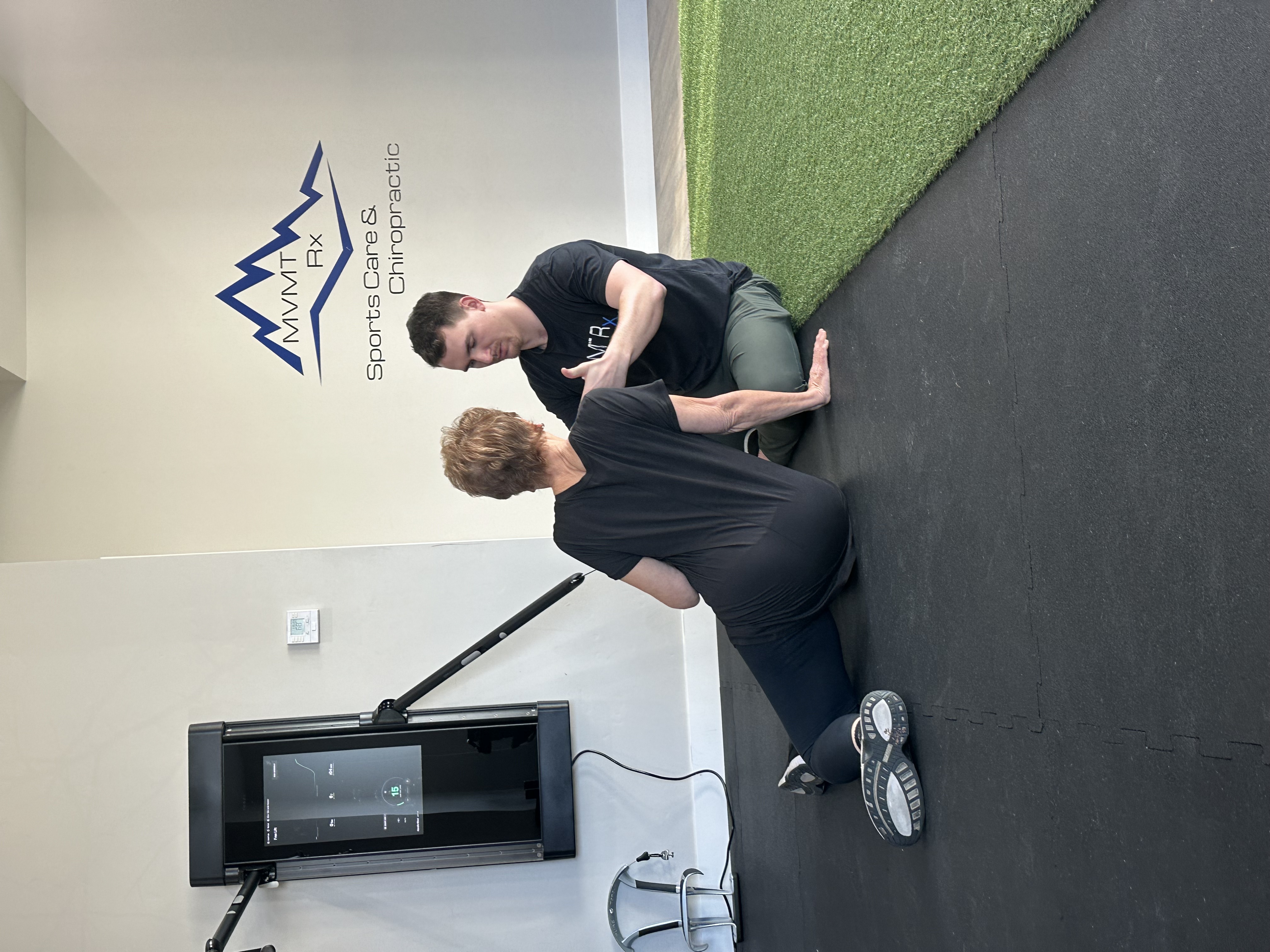
When you come in for a comprehensive movement-based evaluation, we are not just looking at where it hurts. We are looking at how your whole system moves and loads — including your hips, but never only your hips. Here is what that honest, system-level approach sounds like in the room. Instead of telling you "your tight hips are causing your back pain," we will tell you something truer and more useful:
"Objectively, you have a loss of range of motion in your hips. We do not know for sure whether you gradually lost this range and it contributed to your back pain, or whether your back pain led to you slowly losing this range. But what we do know is that most people tend to get better over time when we address these limitations along with the other things we will work on in your program."
That is the difference between a clinic chasing a quick soundbite and a clinic actually trying to get you better and keep you better. Every patient is different, but here is the general shape of how that plays out.
Discovery Visit: A 60-minute, in-person assessment where we walk through your full history, perform a functional evaluation of how your hips, pelvis, trunk, and low back share load, and give you a clear picture of what is actually driving your pain — which is often away from the site of pain entirely. This is a root cause assessment, not a sales pitch. The goal is mutual confidence that you are in the right place and we can help.
Evaluation and First Treatment: If we both agree it is the right fit, we complete the clinical picture with additional objective testing, then turn everything into a structured treatment session so you can experience firsthand what a high-intention, 60-minute session looks like. From there, we make a clinical recommendation on a plan of care — including time, frequency, and investment — decided together.
Ongoing Care: Every session is 60 minutes, one-on-one with your doctor. Your plan adapts weekly based on how your body responds. You receive programming to follow at home, at the gym, or on the road. You are not handed a sheet of exercises and sent on your way — you are coached, progressed, and held accountable through every phase, until you have the confidence and capability to manage your own back for life.
What a low back pain plan at MVMT Rx may include: chiropractic adjustments and Y-strap decompression when appropriate, hip mobility restoration and hip capacity building, glute and hip abductor and extensor strengthening, progressive core and trunk stability training, McKenzie-based directional loading for the lumbar spine, DNS-based core and breathing mechanics, progressive loading of the posterior chain, activity- and sport-specific integration, objective retesting to track measurable progress, and ongoing plan adaptation based on your response.
Learn More: Performance Rehab at MVMT Rx →
How we use objective testing and progressive loading — for hips, trunk, and the whole chain — as part of the RAIL System in Reno and Sparks, NV.
Free Resource
The MVMT Rx Low Back Pain Guide
Our most comprehensive guide to understanding and fixing chronic low back pain — what is actually driving it, why traditional care fails, and what to do about it. Free instant download.
Get the Free Guide →Read the Full Guide: Why a Multi-Modal Approach Works →
Our complete breakdown of the RAIL System, our clinical toolkit, and why single-modality care fails for chronic pain.
Related: Lateral Hip Pain in Women 40–60+ — Why Piriformis Stretches and Cortisone Aren't Fixing It →
If your hip pain is on the outside and flares with side-sleeping and stairs, stretching is the wrong lever. What gluteal tendinopathy actually is, and two tests you can run today.
Related: Why Your Low Back Pain Keeps Coming Back After Every Adjustment →
The adjustment-plus-rehab approach for chronic low back pain — DNS, McKenzie, and progressive loading instead of an endless relief cycle.
Related: Hip Pain — Why Stretching and Foam Rolling Aren't Fixing Your Hips →
Clinical myofascial release, DNS, and progressive hip rehabilitation — why self-stretching fails for chronic hip pain.
Related: Herniated Disc — What Your MRI Isn't Telling You →
Class IV laser therapy, McKenzie assessment, neurodynamics, and progressive loading — why rest and fear make disc herniations worse.
Related: Knee Osteoarthritis — Why Generic Exercise Programs Fail →
Why your X-ray does not define your ceiling, and how objective testing and progressive loading change the outcome for knee OA.
Related: Neck Pain After Failed Chiropractic Care — What's Actually Going On →
Why adjustments alone keep you in a relief cycle, and how McKenzie assessment, neurodynamics, and progressive rehab change the outcome.
Related: Why Your Shoulder Isn't Getting Better →
Rotator cuff tears, impingement myths, and what a doctor-led performance rehab plan actually changes for persistent shoulder pain.
Related: Why Your Plantar Fasciitis Won't Go Away (And What Actually Works) →
Focused shockwave therapy, progressive loading, and clinical neurodynamics — why the stretch-ice-rest cycle fails for chronic heel pain.
Related: Achilles Tendinitis — Why Rest and Stretching Are Making It Worse →
Focused shockwave therapy, progressive loading, and midfoot mobility — why rest and cortisone fail for chronic Achilles tendon pain.
Frequently Asked Questions
Tight Hips & Low Back Pain
Can tight hips cause lower back pain?
Tight hips are associated with low back pain — people with back pain often have less hip mobility, especially less internal rotation — but the research does not support the idea that tight hips directly cause back pain on their own. The relationship runs in more than one direction, and back pain itself can cause the hips to stiffen up. The most accurate view is that your hips are one contributing factor within a larger system, which is why addressing them as part of a complete program tends to help more than stretching alone.
How do I know if my back pain is coming from my hips?
You usually cannot tell on your own, and honestly, neither can a single test. Because hip mobility and back pain influence each other, the only reliable way to understand your specific situation is a thorough movement-based evaluation that looks at how your hips, pelvis, and low back share load together — not just where it hurts. That is what tells us what is actually driving your pain and what your plan should focus on.
Will stretching my hips fix my low back pain?
Stretching might give you temporary relief, but for most people it does not resolve recurring back pain on its own. That is because chasing flexibility does not build the strength, tissue tolerance, and movement capacity that actually make your back resilient. If your back pain keeps coming back, the fix is not more stretching — it is building genuine capacity across your whole system so the same loads stop triggering flare-ups.
Why does my lower back pain keep coming back?
Recurring back pain usually means the underlying capacity of your system has not changed. You get relief, return to normal life, and the same demands that triggered the problem trigger it again. Breaking the cycle requires building real strength, tissue tolerance, motor control, and movement variety so your body becomes harder to knock off track and faster to recover when life stresses it.
Should I get an MRI for my low back pain?
For most low back pain, imaging is not necessary to start getting better, and findings on an MRI often do not match the actual source of symptoms — many pain-free people have "abnormal" findings on their scans. There are specific situations where imaging is genuinely warranted, and we will always tell you if you are one of them. But for the majority of people, a thorough clinical evaluation gives us what we need to build an effective plan right away.
Do you treat low back pain near me in Reno or Sparks?
Yes. MVMT Rx is a sports care and chiropractic clinic serving Reno and Sparks, Nevada. We specialize in helping active people get out of the recurring-pain cycle and back to training, working, and living without their back holding them back. The best first step is a free discovery call so we can understand your situation and see if we are the right fit.
Related conditions and concerns we help active adults with in Reno and Sparks, NV: tight hips and low back pain, recurring and chronic low back pain, hip mobility and back pain, reduced hip internal rotation, hip weakness contributing to back pain, low back pain that returns after every adjustment, failed stretching and foam rolling for back pain, low back pain after physical therapy, sciatica and radiating low back symptoms, SI joint and pelvic-region pain, low back pain in lifters and gym-goers, low back pain in hikers and weekend warriors, desk-related low back stiffness, and low back pain rehab and performance training.
References
- Pizol GZ, Miyamoto GC, Cabral CMN. Hip biomechanics in patients with low back pain, what do we know? A systematic review. BMC Musculoskeletal Disorders. 2024;25:432. doi:10.1186/s12891-024-07463-5
- Avman MA, Osmotherly PG, Snodgrass S, Rivett DA. Is there an association between hip range of motion and nonspecific low back pain? A systematic review. Musculoskeletal Science & Practice. 2019;42:38–51. doi:10.1016/j.msksp.2019.03.002
- Coyle PC, Pugliese JM, Sions JM, et al. Hip range of motion and strength predict 12-month physical function outcomes in older adults with chronic low back pain: the Delaware Spine Studies. ACR Open Rheumatology. 2021;3(11):741–748. doi:10.1002/acr2.11342
- Brinjikji W, Luetmer PH, Comstock B, et al. Systematic literature review of imaging features of spinal degeneration in asymptomatic populations. American Journal of Neuroradiology. 2015;36(4):811–816. doi:10.3174/ajnr.A4173
Stop Guessing About Your Back Pain
If your low back pain keeps coming back, you do not need another stretch you found online. You need a clear answer about what is actually going on — and a plan built to make your back resilient for the long term. Start with a free conversation.
Book Your Free Discovery CallMVMT Rx Sports Care & Chiropractic | Reno & Sparks, NV | (775) 245-4142


Free Guides
Patient Care
Links
© Copyright 2026. MVMT Rx Sports Care & Chiropractic. All Rights Reserved.