
Performance Rehab & Knee Osteoarthritis
Knee Osteoarthritis: Why Generic Exercise Programs Fail and What a Clinical Rehab Plan Actually Looks Like
You were told to strengthen your quads. You did. It did not help. Here is why — and what an actual clinical rehab plan looks like when it is designed by a doctor who understands joint pathology.
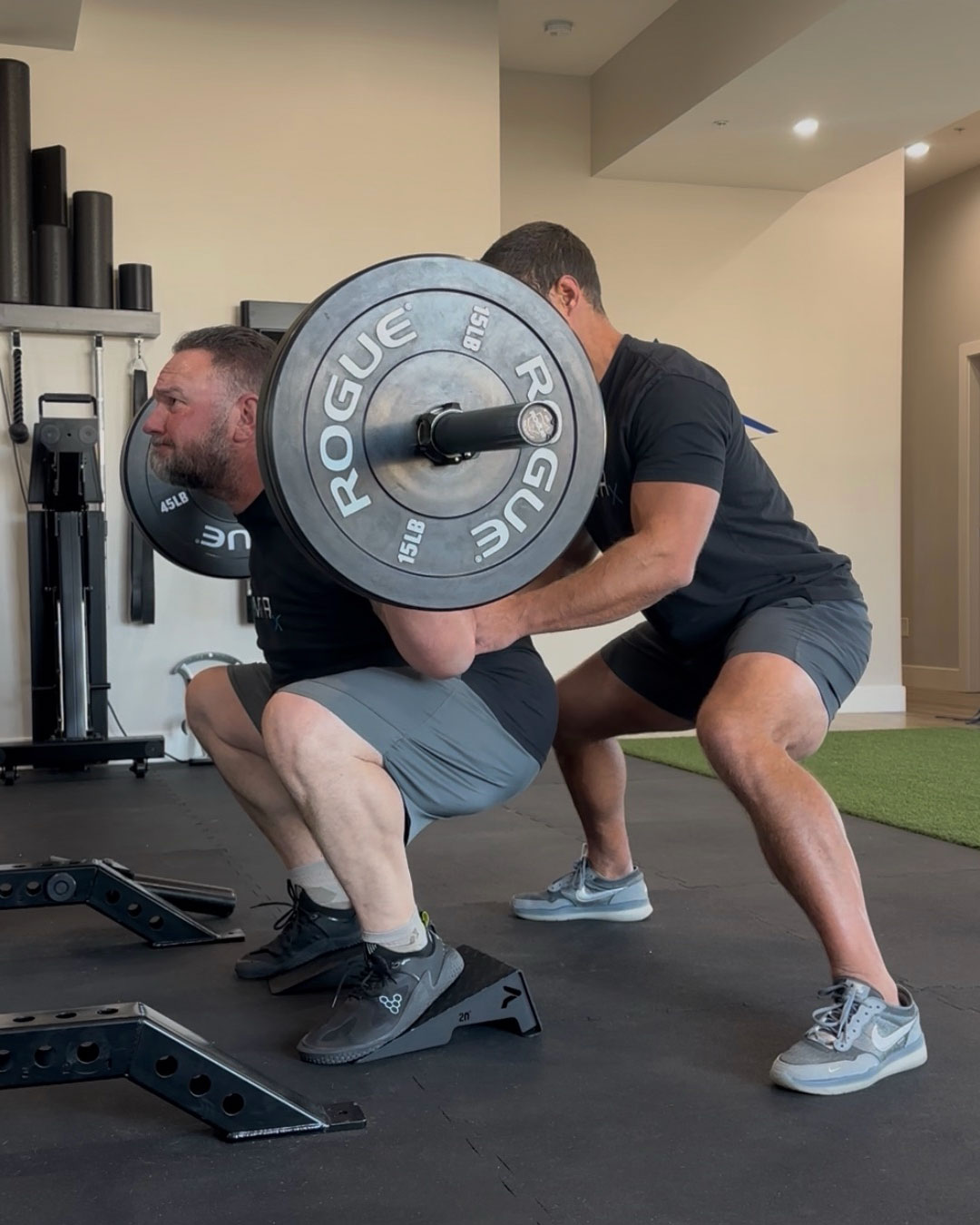
Mike Dianda — "I've literally never felt better."
The Pattern
The Exercise Sheet That Changed Nothing
You went to the orthopedist. They looked at your X-ray, pointed to the narrowing joint space, and said something like: "You have arthritis. You should try physical therapy before we talk about a knee replacement." So you went to PT. You did the quad sets. The straight-leg raises. The mini-squats. The leg extensions. The stretches. You went two or three times a week for six weeks, maybe eight.
And nothing changed.
Maybe you got some temporary relief. Maybe it even felt a little better for a while. But the stiffness after sitting came back. The ache walking downstairs returned. The swelling after a long day on your feet showed up again. And eventually you stopped going — not because you gave up, but because the results did not justify the time, the copays, and the inconvenience. And now you are left with two options that nobody seems to question: keep managing it, or schedule the surgery.
Here is the part nobody told you: the exercise was not wrong. The way it was prescribed was wrong. There is a massive difference between handing someone a sheet of generic quad exercises and building a doctor-designed, progressively adapted clinical rehab plan that accounts for your specific joint pathology, tissue tolerance, limb asymmetries, and the actual demands of your life. One is a gesture toward exercise. The other is a system that changes outcomes.
Common experiences patients describe before finding MVMT Rx: knee pain that worsens with stairs, prolonged sitting, or walking on uneven terrain, failed physical therapy that felt too generic, being told arthritis is "bone on bone" and nothing can be done short of surgery, fear that exercise will make the arthritis worse, stiffness every morning that takes 20 minutes to loosen up, swelling after activity, giving up hiking or pickleball or travel because the knee cannot keep up, and the growing sense that the only option left is a joint replacement.
The Real Issue
Why "Strengthen Your Quads" Is Not a Knee Osteoarthritis Plan
The research on exercise for knee osteoarthritis is overwhelming — and overwhelmingly positive. A landmark 2015 Cochrane review analyzing 54 trials and over 8,000 patients found that therapeutic exercise reduces knee pain and improves physical function in osteoarthritis, with benefits comparable to nonsteroidal anti-inflammatory drugs — without the side effects.[1] The American College of Rheumatology strongly recommends exercise as a first-line treatment for knee OA, ahead of injections, supplements, and surgical consultation.[2]
So if the evidence is this clear, why does exercise fail so often in practice?
Because most exercise programs for knee OA are not clinical rehab plans. They are exercise suggestions — generic, low-dose, poorly progressed, and disconnected from the actual pathology driving the problem. Here is what typically happens: a patient sees a physical therapist two or three times a week. Each visit is 15 to 20 minutes of hands-on time, often supervised by an aide or tech, not the therapist. The exercises are pulled from a standard knee OA protocol. The dosing — sets, reps, load, tempo — is based on what the protocol says, not what the patient's tissue can tolerate and adapt to. There is no objective measurement of quad strength, hamstring endurance, limb symmetry, or functional capacity. There is no progressive overload strategy. And after six to eight weeks, the insurance authorization runs out, the patient is discharged with a home exercise sheet, and told to "keep doing the exercises."
That is not a plan. That is a gesture.
A 2015 trial published in the New England Journal of Medicine compared a structured exercise and education program to total knee replacement for patients with moderate-to-severe knee OA. The exercise group showed significant improvements in pain and function — and two-thirds of the patients in that group decided not to proceed with surgery after completing the program.[3] But the exercise program in that study was not a sheet of quad sets. It was a structured, supervised, progressively loaded clinical intervention delivered over 12 weeks by trained professionals. That is the difference between exercise as a concept and exercise as a clinical tool.
The problem with most PT for knee OA is not that exercise does not work. It is that the dosing is too low, the progression is too slow, the supervision is too thin, and the clinical reasoning is too shallow. When a patient with knee osteoarthritis does leg extensions at the same weight for six weeks and sees no change, the failure is not the patient's. It is the program's.
Why generic knee OA exercise programs fail: insufficient load to drive tissue adaptation, no progressive overload strategy, exercises based on protocols rather than individual assessment, no objective strength or limb symmetry testing, too little hands-on supervision (often delegated to aides), no accounting for joint pathology or tissue irritability, arbitrary timelines driven by insurance authorization rather than clinical progress, and discharge without a long-term capacity-building plan.
Patient Story
Jacquie Was Told She Needed Bilateral Knee Replacements
One PT gave her a 10-minute evaluation and said there was nothing they could do. Another would not even touch her knees. Here is what happened when she found MVMT Rx.
"It's the best investment I've ever made."
Looking Deeper
Arthritis Is Not the Whole Story — And Your X-Ray Is Not Your Destiny
One of the most damaging things that happens in a knee OA consultation is the X-ray conversation. The doctor pulls up the image, points to the joint space, and says something like: "See that? That is bone on bone. That is why you are in pain." And from that moment, the patient believes they are broken. They believe the joint is destroyed. They believe movement will make it worse. And they start avoiding exactly the thing that could help them most.
Here is what that conversation leaves out: imaging findings correlate poorly with symptoms. A 2008 study in the BMJ found that radiographic severity of knee OA explains only a modest proportion of pain variance — meaning many people with severe-looking X-rays have minimal pain, and many with mild-looking X-rays have significant pain.[4] Your X-ray shows structural change. It does not tell you how much pain you should have, how much function you should have, or what you are capable of.
At MVMT Rx, we do not ignore the arthritis. It is real, and it matters. But we refuse to let it define the ceiling of what is possible. What we consistently find in our clinical experience is that the pain and functional limitation from knee OA are driven as much by capacity deficits around the joint as by the structural changes inside it.
When the quadriceps are weak, the knee absorbs more compressive force with every step. When the hip lacks strength and stability, the knee absorbs forces it was never designed to handle on its own — taking on extra stress with every step, squat, and stair. When the calf lacks endurance, gait mechanics deteriorate by the end of the day. When the hamstrings and posterior chain cannot absorb force efficiently, the anterior knee takes the hit. These are not things an X-ray shows. And they are not things a generic exercise sheet addresses.
Common root cause drivers of knee OA pain and limitation: quadriceps strength deficits and atrophy, hamstring and posterior chain weakness, hip strength and stability deficits that force the knee to absorb excess stress, calf and soleus endurance deficits altering gait, limited knee flexion range of motion, limited ankle dorsiflexion affecting squat and stair mechanics, quadriceps-to-hamstring strength imbalances, limb symmetry deficits between affected and unaffected sides, poor lumbopelvic control and hip centration deficits that alter lower extremity mechanics, deconditioning from prolonged activity avoidance, and loss of confidence in the knee's ability to handle load.
This is also where our training in Dynamic Neuromuscular Stabilization (DNS) plays a critical role. The hip joint — like the shoulder — depends on proper centration to function well under load. When the hip is not well centrated, the muscles surrounding the joint cannot contract efficiently, and the knee ends up compensating for force that should be managed at the hip. DNS allows us to restore lumbopelvic control and hip centration — training proper intra-abdominal pressure and the correct orientation of the ribcage relative to the pelvis — so that trunk stability, hip mobility, and lower extremity mechanics all improve together. When the hip moves better and the trunk stabilizes better, the stress distribution through the knee changes dramatically.
We use objective measurements — dynamometer testing for quad and hamstring strength, range of motion assessment, functional movement analysis under load — to quantify exactly where the deficits are. We calculate limb symmetry by comparing force output between your affected and unaffected sides. Then we go a step further: we compare your results to normative data derived from hundreds of thousands of pain-free active adults, using torque values that account for your body weight and limb length — so the comparison is relative to your size, not some arbitrary benchmark. That data drives the plan. Not a protocol. Not a guess. Not an X-ray.
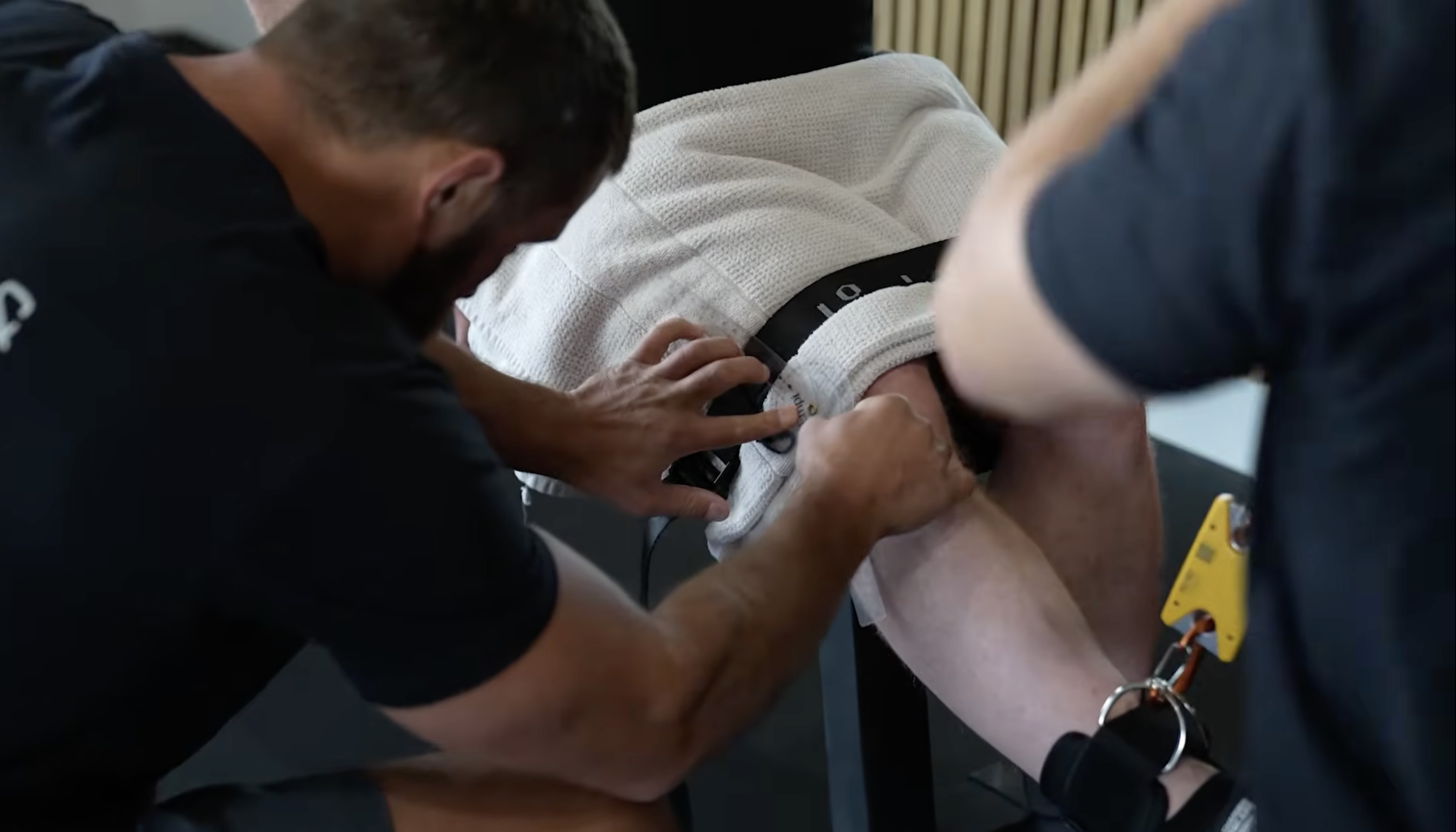
Objective strength and range of motion testing with dynamometer and inclinometer — this is how we measure what matters.

Actual objective data that drives decision making and monitors progress.
A Different Approach
What a Doctor-Led Clinical Rehab Plan Actually Looks Like
At MVMT Rx, we use a clinical reasoning framework called the RAIL System that guides every decision we make. It is not a marketing label. It is the clinical logic behind how we sequence treatment, dose exercise, and progress patients from pain to performance. For knee osteoarthritis, this framework is what separates outcomes that plateau after six weeks from outcomes that continue building for months.
Relief — The first priority is to calm the joint down enough to create a window for real work. For knee OA, this often includes chiropractic adjustments to restore patellar and tibiofemoral joint mobility, Class IV laser to manage inflammation and pain signaling, soft tissue work on the quad, ITB, and calf complex, and activity modification so you are not constantly re-aggravating the joint. Relief matters — but at MVMT Rx, it is the starting line, not the finish line. And this is where doing everything under one roof matters. The adjustment, the laser, and the first round of loading happen in the same session, with the same doctor. We create the window and then immediately use it — like hitting the save button on the changes we just made, instead of hoping they hold until next time.
Adaptation — This is where the real work begins, and where most programs fail. We start building quadriceps strength, hamstring capacity, hip stability, and calf endurance through progressively dosed exercise — not generic sets and reps, but loading that is calibrated to your current tissue tolerance and advanced systematically as your body adapts. We use objective testing to set baselines and track progress. Every exercise has a purpose, a dose, and a progression threshold. When the numbers improve, the program advances. When they stall, we adjust. This is clinical dosing, not workout programming.
Integration — This is the phase most knee OA patients never reach — and it is arguably the most important one. Early in Integration, we start challenging the body with complex multi-joint exercises, driving real strength and power adaptations in the quads, posterior chain, and entire lower extremity. We add plyometric progressions when applicable — teaching the knee to absorb and produce force quickly and confidently, which is exactly what it needs to handle stairs, uneven terrain, and sport without breaking down. As you progress, we blend your real-world demands — hiking trails, playing pickleball, keeping up with the grandkids on a trip to Europe, getting on and off the floor — heavily with the gym work for optimal transferability. By the end of this phase, we are not just managing your knee. We are building a lower body that is harder to break than it was before the arthritis was ever diagnosed.
Lifespan — Patients do not get discharged from MVMT Rx. They graduate. You leave with the strength, the capacity, the movement literacy, and the confidence to manage your knee for decades. The arthritis does not disappear — but your ability to live fully despite it transforms completely. Periodic check-ins, programming updates, and re-engagement when a new goal or challenge comes up keep you on track for the long haul.
The arthritis is still there. The limitation does not have to be.
What This Looks Like
What a Knee OA Plan Actually Looks Like at MVMT Rx
Every patient is different, but here is the general shape of how we approach knee osteoarthritis — the kind that has not responded to generic PT, cortisone injections, supplements, or the "just live with it" advice you have heard one too many times.
Discovery Visit: A 60-minute, in-person assessment where we walk through your full history — including every provider you have seen, every treatment you have tried, and every activity you have given up because of the knee. We perform a functional evaluation of the entire lower extremity chain — not just the knee — and give you a clear picture of what is actually driving your pain and limitation. We test quad strength, hamstring capacity, hip stability, ankle mobility, and how your body moves under load. This is a root cause assessment, not a sales pitch. The goal is mutual confidence that you are in the right place and we can help.
Evaluation and First Treatment: If we both agree it is the right fit, we complete the clinical picture with additional assessment, then turn everything into a structured treatment session so you can experience firsthand what a high-intention, 60-minute session looks like — manual therapy, targeted loading, and clinical coaching in the same visit. From there, we make a clinical recommendation on a plan of care — including time, frequency, and investment — decided together.
Ongoing Care: Every session is 60 minutes, one-on-one with your doctor. Your plan adapts weekly based on how your body responds — not based on a six-week protocol or insurance authorization. You receive programming to follow at home, at the gym, or on the road. You are coached, progressed, and held accountable through every phase. And you develop the movement literacy and body awareness to confidently manage your own knee for life — in any gym, on any trail, in any situation.
What a knee OA plan at MVMT Rx may include: chiropractic adjustments to restore patellar and tibiofemoral joint mobility, Class IV laser for inflammation and pain management, progressive quadriceps strengthening from isometrics through heavy compound loading, hamstring and posterior chain capacity building, hip strengthening to reduce excess stress on the knee, calf and soleus endurance training, balance and proprioceptive work, gait mechanics assessment and correction, sport-specific and activity-specific loading progressions, objective retesting with dynamometer and limb symmetry index to track measurable progress, and ongoing plan adaptation based on your response.
Learn More: Performance Rehab at MVMT Rx →
How we use doctor-led, progressively loaded clinical rehabilitation to rebuild strength, capacity, and confidence for active adults in Reno and Sparks, NV.
Free Assessment
How Bad Is Your Knee Osteoarthritis — Really?
Answer 13 questions to find out why you are feeling stuck and what to do about it. Takes less than 3 minutes. Free and instant results.
Take the Free Quiz →Read the Full Guide: Why a Multi-Modal Approach Works →
Our complete breakdown of the RAIL System, our clinical toolkit, and why single-modality care fails for chronic pain.
Related: Why Your Low Back Pain Keeps Coming Back After Every Adjustment →
The same RAIL System approach applied to chronic low back pain — why adjustments alone fall short and what a multi-modal plan changes.
Related: Why Your Plantar Fasciitis Won't Go Away (And What Actually Works) →
Focused shockwave therapy, progressive loading, and clinical neurodynamics — why the stretch-ice-rest cycle fails for chronic heel pain.
Related: Why Your Shoulder Isn't Getting Better →
Rotator cuff tears, impingement myths, and what a doctor-led performance rehab plan actually changes for persistent shoulder pain.
Related: Neck Pain After Failed Chiropractic Care — What's Actually Going On →
Why adjustments alone keep you in a relief cycle, and how McKenzie assessment, neurodynamics, and progressive rehab change the outcome.
Related: Achilles Tendinitis — Why Rest and Stretching Are Making It Worse →
Focused shockwave therapy, progressive loading, and midfoot mobility — why rest and cortisone fail for chronic Achilles tendon pain.
Related: Hip Pain — Why Stretching and Foam Rolling Aren't Fixing Your Hips →
Clinical myofascial release, DNS, and progressive hip rehabilitation — why self-stretching fails for chronic hip pain.
Related: Herniated Disc — What Your MRI Isn't Telling You →
Class IV laser therapy, McKenzie assessment, neurodynamics, and progressive loading — why rest and fear make disc herniations worse.
Related: The Hidden Cost of Daily Tylenol and NSAIDs →
What the research says about daily OTC painkiller use — liver damage, GI bleeding, cardiovascular risk, delayed healing, and why your pain deserves a better answer than medication.
Frequently Asked Questions
Knee Osteoarthritis & Clinical Rehab
Can exercise actually help knee osteoarthritis, or will it make it worse?
The research is clear: properly dosed exercise is one of the most effective natural treatments for knee OA. It reduces pain, improves function, and builds the muscular capacity that protects the joint from further breakdown. The key is "properly dosed." Too little load produces no adaptation. Too much load aggravates the joint. Clinical rehab finds the dose that drives tissue change without exceeding the joint's current tolerance — and advances it systematically as capacity builds.
My doctor said I am bone on bone. Is it too late for rehab?
Imaging findings do not determine your ceiling. Many patients with severe-looking X-rays achieve dramatic improvements in pain and function through clinical rehab — because much of the pain and limitation comes from capacity deficits around the joint, not just structural changes inside it. We have worked with patients who were told the only option was surgery and watched them return to hiking, pickleball, and travel after rebuilding the strength and stability their knee was missing. The arthritis does not disappear, but the limitation often does.
How is this different from the PT I already tried?
Three things. First, every session is 60 minutes, one-on-one with your doctor — you are never handed off to an aide. Second, your program is built from objective strength and symmetry data, not a standard knee OA protocol — and it adapts weekly based on how your body responds. Third, we combine manual therapy, clinical rehab, and progressive loading under one roof in the same session — so the adjustment, the laser, and the exercise all reinforce each other instead of happening in separate offices on separate days.
Will I still need a knee replacement eventually?
Some patients will. But the research shows that a meaningful percentage of patients who complete structured clinical rehab programs decide not to proceed with surgery — because their pain and function improve enough that the risk and recovery of a replacement no longer make sense. And for patients who do eventually choose surgery, stronger muscles and better movement quality going in produce significantly better surgical outcomes and faster recovery afterward. Either way, clinical rehab is not wasted effort.
What about supplements like glucosamine, turmeric, or collagen?
The evidence for most joint supplements is weak. Glucosamine and chondroitin have shown minimal benefit over placebo in large-scale trials. Turmeric may have modest anti-inflammatory effects but is not a substitute for building the muscular capacity that protects the joint. We are not against supplements if a patient wants to use them, but we are against using them as a replacement for the one intervention that consistently shows meaningful, lasting results: progressive, properly dosed exercise under clinical supervision.
Do you accept insurance?
MVMT Rx is a cash-pay practice. We provide superbills that you can submit to your insurance for potential reimbursement depending on your plan. We also offer in-house payment plans, CareCredit (no- and low-interest medical financing), and paid-in-full discounts for patients who are fully invested and ready to commit to the process.
References
- Fransen M, McConnell S, Harmer AR, et al. Exercise for osteoarthritis of the knee: a Cochrane systematic review. Cochrane Database of Systematic Reviews. 2015;(1):CD004376. doi:10.1002/14651858.CD004376.pub3
- Kolasinski SL, Neogi T, Hochberg MC, et al. 2019 American College of Rheumatology/Arthritis Foundation Guideline for the Management of Osteoarthritis of the Hand, Hip, and Knee. Arthritis Care & Research. 2020;72(2):149–162. doi:10.1002/acr.24131
- Skou ST, Roos EM, Laursen MB, et al. A Randomized, Controlled Trial of Total Knee Replacement. New England Journal of Medicine. 2015;373(17):1597–1606. doi:10.1056/NEJMoa1505467
- Bedson J, Croft PR. The discordance between clinical and radiographic knee osteoarthritis: a systematic review and summary of the literature. BMC Musculoskeletal Disorders. 2008;9:116. doi:10.1186/1471-2474-9-116
- Messier SP, Mihalko SL, Beavers DP, et al. Effect of High-Intensity Strength Training on Knee Pain and Knee Joint Compressive Forces Among Adults With Knee Osteoarthritis: The START Randomized Clinical Trial. JAMA. 2021;325(7):646–657. doi:10.1001/jama.2021.0411
Told Your Only Option Is Surgery?
If generic PT did not work and you have been told to just live with it or schedule a replacement — there is a step between doing nothing and going under the knife. Start with a free conversation.
Book Your Free Discovery CallMVMT Rx Sports Care & Chiropractic | Reno & Sparks, NV | (775) 245-4142


Free Guides
Patient Care
Links
© Copyright 2026. MVMT Rx Sports Care & Chiropractic. All Rights Reserved.