
Chiropractic Adjustments & Low Back Pain
Why Your Low Back Pain Keeps Coming Back After Every Adjustment
You feel better for a day or two. Then it returns. Here is why — and what a different approach looks like.
The Pattern
The Adjustment Cycle You Already Know
Your back goes out. Maybe it is a sharp catch when you bend over. Maybe it is a deep ache that builds through the day until you cannot sit comfortably. Either way, you know the drill — you call your chiropractor, get adjusted, and walk out feeling significantly better.
For a day. Maybe two.
Then it creeps back. The stiffness returns. The ache settles in. So you go again. And again. Weeks become months. You keep going because the adjustments help — they genuinely do — but at some point you start asking a question that most chiropractors never fully answer:
Why does this keep coming back?
That question is not a criticism of chiropractic care. It is the most important clinical question a provider can ask. And the answer, in almost every case we see, is not that your spine is "out of alignment" or that your bones keep "going out of place." The answer is that the adjustment is doing exactly what it is designed to do — providing relief — but relief alone was never going to solve the problem.
Common experiences patients describe before finding MVMT Rx: recurring low back pain that returns days after each adjustment, temporary relief that never becomes permanent, being told the spine is "out of alignment," multiple visits per week for months with no lasting change, feeling dependent on adjustments to function, and a growing sense that something is being missed.
The Real Issue
What Adjustments Actually Do — and What They Do Not
A chiropractic adjustment is one of the most effective natural tools available for reducing pain, restoring joint mobility, and calming an irritated nervous system. The research supports this clearly. A 2017 study in the Journal of the American Medical Association found that spinal manipulation produced modest improvements in pain and function for acute low back pain compared to sham interventions. A 2019 systematic review in the BMJ confirmed short-term benefits for chronic low back pain when manipulation was combined with other interventions.
The key phrase in that research is "combined with other interventions."
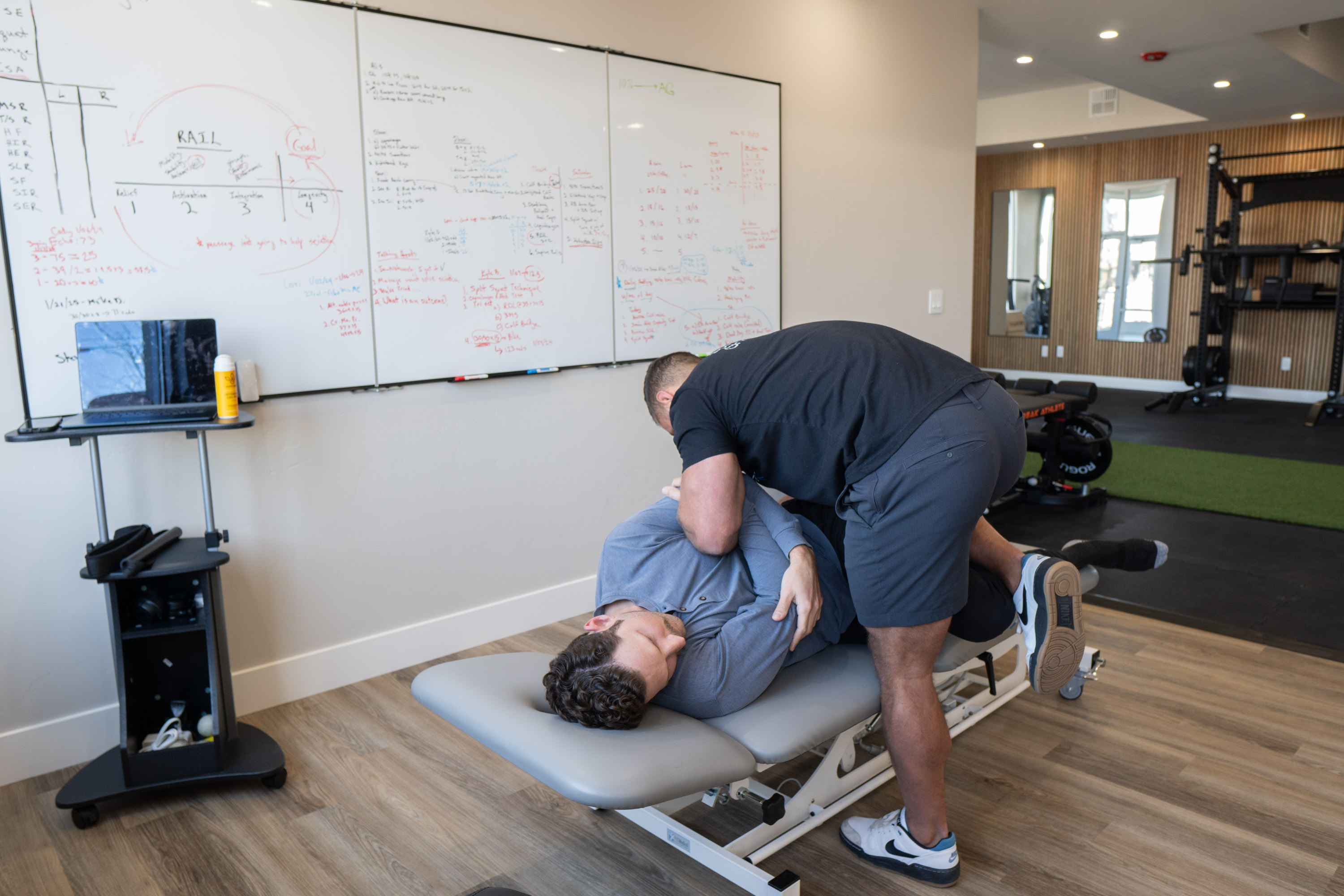
An adjustment changes how a joint moves in the moment. It can reduce muscle guarding, improve range of motion, decrease pain signaling, and create a neurological window where the body can start functioning more normally. That is valuable. At MVMT Rx, we use adjustments — including Y-strap decompression — as a core part of our care. We are not against adjustments. We perform them daily.
But here is what an adjustment does not do: it does not strengthen a weak core. It does not improve the endurance of the muscles that stabilize your spine under load. It does not correct the movement compensations you have built over years of working around pain. It does not rebuild the tissue tolerance that has been lost from months or years of avoiding the activities that challenge your body.
And yet, most chiropractic offices are built around the adjustment as the entire plan. The typical visit lasts three to five minutes. You walk in, lie on a table, receive the same series of adjustments as every other patient that day, and walk out. There is no assessment of why the pain keeps returning. There is no progressive loading, no exercise, no coaching, no customization. It is a conveyor belt — high volume, low contact, and the same protocol regardless of whether you are a 55-year-old hiker or a 30-year-old desk worker.
Some offices take it further. Gonstead and structural-correction chiropractors often require X-rays on the first visit and use the images as a sales tool — circling "misalignments" or "degeneration" to justify a large treatment package before a single functional test is performed. The problem is that imaging findings like disc bulges, arthritis, and curvature changes are common in people with zero pain. Your X-ray often has very little to do with your pain or your functional limitations. Using it as the basis of a care plan tells you more about the business model than the clinical reasoning.
When a provider treats low back pain exclusively with adjustments — three times a week, indefinitely — they are treating the symptom without ever addressing the capacity deficit underneath it. The adjustment creates a window of relief. But if nothing is done inside that window to rebuild what is actually weak, stiff, or deconditioned, the window closes. And the pain comes back.
That is not a failure of chiropractic. It is a failure of approach.
This is also why doing everything under one roof matters. At MVMT Rx, the adjustment and the rehabilitation happen in the same session, with the same doctor. We adjust, then we load — strategically, immediately, while your system is more mobile, less inflamed, less painful, and more confident. It is like hitting the save button on the changes the adjustment just made. Instead of walking out of the office and hoping your body holds, we use that window to train your body to keep the improvement. That is the difference between temporary relief and lasting capacity.
Looking Deeper
The Root Cause Is Rarely Where the Pain Is
One of the most common mistakes in low back pain treatment — across chiropractic, physical therapy, and medicine — is assuming the site of pain is the source of the problem. You hurt in your low back, so the treatment targets your low back. It sounds logical. But in our clinical experience, spanning over twenty combined years and thousands of patients, the low back is almost never where the problem actually started.
The low back is where the problem ended up.
Chronic low back pain in active adults is frequently the result of capacity deficits and compensations that have been building for years. A hip that lost rotational range of motion forces the lumbar spine to rotate more than it was designed to. An ankle that never fully recovered from an old sprain changes how you load your leg, shifting stress up the chain. A core that was never trained to stabilize under real-world demand leaves the spine doing work the surrounding musculature should be handling.
These are not things that show up on an X-ray. They do not appear in a standard orthopedic exam. And they are certainly not addressed by adjusting the same lumbar segments three times a week.
At MVMT Rx, we use a functional assessment to identify where the real drivers are — not just where the pain presents. We look at hip mobility, ankle function, trunk stability, single-leg balance, movement quality under load, and how your body responds to specific demands. We use objective measurements — dynamometer testing, range of motion data, limb symmetry comparisons — to quantify what is actually limited. Then we build a plan that addresses those specific deficits, not a generic protocol based on a diagnosis code.
Common root cause drivers of recurring low back pain: hip rotational deficits, poor trunk stability under load, ankle mobility restrictions, lateral strength and stability deficits and asymmetries (glute medius and adductor complex), thoracic spine stiffness, quad and hamstring strength or endurance deficits that overload the spine upstream, deconditioning from prolonged inactivity, compensatory movement patterns from old injuries, and insufficient capacity for daily physical demands.
Addressing these drivers requires more than adjustments and stretches. Our training in Dynamic Neuromuscular Stabilization (DNS) allows us to retrain how your brain organizes core stability from the inside out — teaching proper intra-abdominal pressure and maintaining the correct orientation of the ribcage relative to the pelvis. When this system works properly, the lumbar and thoracic spine decompress naturally, hip mobility opens up, and the spine stops absorbing forces it was never designed to handle alone. This is not bracing harder. It is learning how to stabilize the way your body was designed to — and it changes everything downstream.
We also integrate McKenzie-based assessment (MDT) in the lumbar spine — a clinical method that identifies directional preferences in how your spine responds to movement. Beyond assessment, McKenzie-based loading acts as a mechanical pump for the disc and surrounding tissues — driving congestion and waste products out while allowing fresh blood supply and nutrients back in. This improves the health of the localized tissue, restores mobility, and creates an environment where healing can actually occur. It is one of the most effective and underused tools in low back care.
A Different Approach
How We Use Adjustments Inside the RAIL System
At MVMT Rx, chiropractic adjustments are not the plan. They are Phase 1 of the plan.
We use a clinical reasoning framework called the RAIL System that guides every decision we make. RAIL stands for Relief, Adaptation, Integration, and Lifespan. Each phase has a specific purpose, and understanding the purpose of each phase is what separates outcomes that last from outcomes that fade.
Relief — This is where adjustments live. When you walk in hurting, the first priority is to reduce pain and irritation enough that your body can start doing real work. Adjustments, soft tissue therapy, laser, mobility work — these are all tools we use to calm the system and create a window. Relief is valuable. It is necessary. And it is where most providers stop.
Adaptation — Once the system has calmed down, we begin rebuilding your body's tolerance through progressively dosed exposures. Targeted exercises, controlled loading, building endurance and stability in the specific areas that testing identified as deficient. The goal is resilience — a body that bounces back quickly when life throws something at it, instead of a body that needs an adjustment every time it flares up.
Integration — This is the phase most patients never reach with traditional care, and it is arguably the most important one. Early in Integration, we start challenging the body with complex multi-joint exercises, driving real strength and power adaptations in the trunk, hips, and entire posterior chain. We add plyometric progressions when applicable — teaching your body to absorb and produce force quickly and confidently. As you progress, we blend your real-world demands — hiking on uneven terrain, lifting something heavy off the floor, reacting quickly to catch your balance — heavily with the gym work for optimal transferability. By the end of this phase, we are not just managing your low back. We are building a body that is hard to break.
Lifespan — Patients do not get discharged from MVMT Rx. They graduate. By this point, you are resilient, you are robust, and you have the tools to manage your own body long-term. The structured care relationship shifts to maintenance — periodic check-ins, programming updates, and re-engagement when a new goal or challenge comes up.
The adjustment got you in the door. The system keeps you out of pain for good.
What This Looks Like
What a Low Back Pain Plan Actually Looks Like at MVMT Rx
Every patient is different, but here is the general shape of how we approach chronic or recurring low back pain — the kind that has not responded to adjustments alone, physical therapy protocols, or the "just stretch more" advice you have heard a dozen times.
Discovery Visit: A 60-minute, in-person assessment where we walk through your full history, perform a functional evaluation, and give you a clear picture of what is actually driving your pain — which is often away from the site of pain entirely. This is a root cause assessment, not a sales pitch. The goal is mutual confidence that you are in the right place and we can help.
Evaluation and First Treatment: If we both agree it is the right fit, we complete the clinical picture with additional assessment, then turn everything into a structured treatment session so you can experience firsthand what a high-intention, 60-minute session looks like. From there, we make a clinical recommendation on a plan of care — including time, frequency, and investment — decided together.
Ongoing Care: Every session is 60 minutes, one-on-one with your doctor. Your plan adapts weekly based on how your body responds. You receive programming to follow at home, at the gym, or on the road. You are not handed a sheet of exercises and sent on your way. You are coached, progressed, and held accountable through every phase of recovery.
What a low back pain plan at MVMT Rx may include: chiropractic adjustments and Y-strap decompression, progressive core stability and trunk endurance training, low back endurance and strength development, hip mobility restoration and hip and trunk power training, gluteal activation and strengthening, dynamic stabilization drills, sport-specific or activity-specific loading, building body awareness and training acumen so you feel confident stepping into any gym or performing any movement or exercise with confidence, objective retesting to track measurable progress, and ongoing plan adaptation based on your response.
Learn More: Chiropractic Adjustments at MVMT Rx →
How we use spinal and extremity adjustments — including Y-strap decompression — as part of the RAIL System in Reno and Sparks, NV.
Free Resource
The MVMT Rx Low Back Pain Guide
Our most comprehensive guide to understanding and fixing chronic low back pain — what is actually driving it, why traditional care fails, and what to do about it. Free instant download.
Get the Free Guide →Read the Full Guide: Why a Multi-Modal Approach Works →
Our complete breakdown of the RAIL System, our clinical toolkit, and why single-modality care fails for chronic pain.
Related: Do Tight Hips Cause Low Back Pain? →
The honest answer on hip mobility and back pain — what the research actually shows, and why building hip capacity beats chasing a stretch.
Related: Why Your Plantar Fasciitis Won't Go Away (And What Actually Works) →
The same RAIL System approach applied to chronic heel pain — shockwave therapy, progressive loading, and why the stretch-ice-rest cycle fails.
Related: Knee Osteoarthritis — Why Generic Exercise Programs Fail →
Why your X-ray does not define your ceiling, and how objective testing and progressive loading change the outcome for knee OA.
Related: Why Your Shoulder Isn't Getting Better →
Rotator cuff tears, impingement myths, and what a doctor-led performance rehab plan actually changes for persistent shoulder pain.
Related: Neck Pain After Failed Chiropractic Care — What's Actually Going On →
Why adjustments alone keep you in a relief cycle, and how McKenzie assessment, neurodynamics, and progressive rehab change the outcome.
Related: Achilles Tendinitis — Why Rest and Stretching Are Making It Worse →
Focused shockwave therapy, progressive loading, and midfoot mobility — why rest and cortisone fail for chronic Achilles tendon pain.
Related: Hip Pain — Why Stretching and Foam Rolling Aren't Fixing Your Hips →
Clinical myofascial release, DNS, and progressive hip rehabilitation — why self-stretching fails for chronic hip pain.
Related: Herniated Disc — What Your MRI Isn't Telling You →
Class IV laser therapy, McKenzie assessment, neurodynamics, and progressive loading — why rest and fear make disc herniations worse.
Related: Moms and Grandmas — Your Low Back Pain Is Not Something You Have to Live With →
A chiropractor shares the story of his wife's transformation from barely walking to hiking 15 miles — and why DNS, progressive loading, and whole-system assessment change everything for women with chronic low back pain.
Frequently Asked Questions
Low Back Pain & Chiropractic Care
Are you saying chiropractic adjustments do not work?
Not at all. Adjustments are one of the most effective natural tools for reducing pain and restoring joint mobility. We use them daily at MVMT Rx. The issue is when adjustments are the only tool in the plan. Relief is the starting line — not the finish line. Long-term results require building the capacity to keep pain from returning.
How is MVMT Rx different from other chiropractors in Reno?
Three things. First, every session is 60 minutes, one-on-one with your doctor — you are never handed off. Second, we combine chiropractic care with progressive rehabilitation, shockwave therapy, laser, and myofascial release under one roof. Third, we use objective testing and a clinical reasoning model called the RAIL System to guide every decision — not generic protocols.
My chiropractor says my spine is out of alignment. Is that true?
Spines do not go "out of place" in the way that phrase implies. Your spine is a strong, stable, adaptable structure. The idea that bones are misaligned and need to be put back is an outdated model that often creates more fear than clarity. What is usually happening is that certain joints are not moving well, the surrounding muscles are guarding, and the nervous system is sensitized. Adjustments help with all of that — but the language of "alignment" can make your body sound more fragile than it actually is.
How long does a typical plan of care last for low back pain?
Most plans run three to five months depending on how long the issue has been present, how your body responds, and what your goals are. Some patients with acute episodes improve faster. Patients with years of chronic pain and multiple failed treatments typically need longer to rebuild the capacity that has been lost. We lay this out clearly after the evaluation so there are no surprises.
Do I need X-rays before starting care?
In most cases, no. We do not require imaging to begin care, and we do not sell treatment plans based on X-ray findings. If imaging is clinically indicated — such as a history of trauma, red flag symptoms, or suspicion of a structural issue that would change the plan — we will refer you for it. But for the majority of chronic low back pain cases, functional assessment tells us far more than imaging does.
Do you accept insurance?
MVMT Rx is a cash-pay practice. We provide superbills that you can submit to your insurance for potential reimbursement depending on your plan. We also offer in-house payment plans, CareCredit (no- and low-interest medical financing), and paid-in-full discounts for patients who are fully invested and ready to commit to the process.
References
- Paige NM, Miake-Lye IM, Booth MS, et al. Association of Spinal Manipulative Therapy With Clinical Benefit and Harm for Acute Low Back Pain: Systematic Review and Meta-analysis. JAMA. 2017;317(14):1451–1460. doi:10.1001/jama.2017.3086
- Rubinstein SM, de Zoete A, van Middelkoop M, et al. Benefits and harms of spinal manipulative therapy for the treatment of chronic low back pain: systematic review and meta-analysis of randomised controlled trials. BMJ. 2019;364:l689. doi:10.1136/bmj.l689
- Owen PJ, Miller CT, Mundell NL, et al. Which specific modes of exercise training are most effective for treating low back pain? Network meta-analysis. British Journal of Sports Medicine. 2020;54(21):1279–1287. doi:10.1136/bjsports-2019-100886
- Searle A, Spink M, Ho A, Chuter V. Exercise interventions for the treatment of chronic low back pain: a systematic review and meta-analysis of randomised controlled trials. Clinical Rehabilitation. 2015;29(12):1155–1167. doi:10.1177/0269215515570379
- Saragiotto BT, Maher CG, Yamato TP, et al. Motor control exercise for chronic non-specific low-back pain. Cochrane Database of Systematic Reviews. 2016;(1):CD012004. doi:10.1002/14651858.CD012004
Done Chasing Temporary Relief?
If your low back pain keeps coming back no matter how many times you get adjusted, the problem is not the adjustment — it is the plan. Start with a free conversation.
Book Your Free Discovery CallMVMT Rx Sports Care & Chiropractic | Reno & Sparks, NV | (775) 245-4142



Free Guides
Patient Care
Links
© Copyright 2026. MVMT Rx Sports Care & Chiropractic. All Rights Reserved.