
Performance Rehab & Shoulder Pain
Why Your Shoulder Isn't Getting Better — And What a Doctor-Led Rehab Plan Changes
You have done the rotator cuff exercises. You have rested. You have iced. And the shoulder still will not cooperate. Here is why — and what actually changes the outcome.
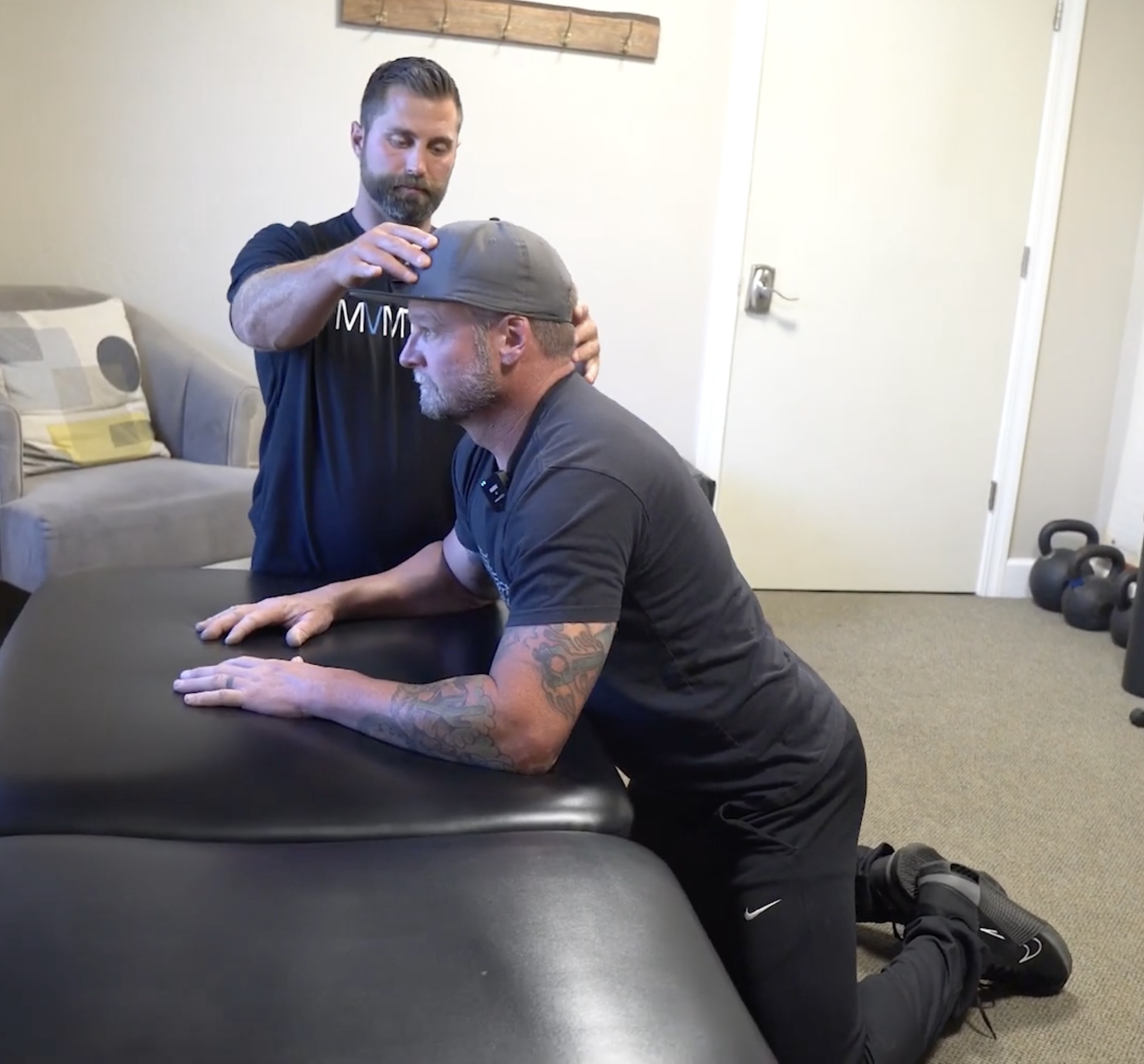
Dr. Kyle working with Adam Benge on thoracic spine and ribcage mobility — a critical and often-missed driver of shoulder pain.
The Pattern
The Shoulder Rehab Loop You Are Stuck In
It started with a twinge. Maybe reaching overhead. Maybe during a workout. Maybe rolling over in bed. You ignored it for a while because that is what you do. Then it got worse. So you went to the doctor. They ordered an MRI, told you that you have a rotator cuff tear — or impingement, or bursitis, or tendinopathy — and sent you to physical therapy.
You did the exercises. The band pull-aparts. The external rotations. The wall slides. You went two or three times a week for six to eight weeks. Maybe it got a little better. Maybe it did not. Either way, the insurance ran out, you were discharged with a sheet of exercises, and told to "keep doing them at home."
You tried. For a while. But the shoulder still catches when you reach behind your back. It still aches after a long day. You still cannot sleep on that side. And you have started avoiding things — the overhead press, throwing the ball with your kid, reaching for something on the top shelf — because you do not trust it anymore.
That loss of trust might be the biggest problem of all. Not because the shoulder is fragile — but because the avoidance is making everything worse.
Common experiences patients describe before finding MVMT Rx: shoulder pain that persists despite months of rotator cuff exercises, being told to avoid overhead movements indefinitely, failed physical therapy that felt too generic and low-intensity, an MRI showing a tear followed by a recommendation for surgery, pain that improves slightly with rest but returns immediately with activity, inability to sleep on the affected side, fear of making the shoulder worse by exercising, loss of confidence in the shoulder during daily activities and recreation, and the growing sense that nothing is actually changing.
The Real Issue
Why Band Exercises and Rest Are Not Fixing Your Shoulder
The standard approach to shoulder pain has two speeds: rest or surgery. If it is not "bad enough" for surgery, you are told to rest, do gentle exercises, maybe get a cortisone injection, and wait. If it does not improve, the conversation shifts to surgical repair. What almost never happens is a middle ground where someone builds your shoulder's actual capacity to handle the demands you are placing on it.
This is the gap where most shoulder patients live — and most providers never address it.
Here is the first thing to understand: a rotator cuff tear on an MRI does not automatically mean you need surgery. A 2013 study in the Journal of Bone and Joint Surgery found that rotator cuff tears are present in a significant number of people with zero shoulder pain — and the prevalence increases with age regardless of symptoms.[1] A 2019 systematic review in the British Journal of Sports Medicine found that for most non-traumatic rotator cuff tears, exercise-based rehabilitation produces outcomes comparable to surgical repair at one- and two-year follow-ups.[2]
This does not mean tears do not matter. It means that the presence of a tear on imaging does not tell you why your shoulder hurts or what to do about it. The tear may be incidental. The pain may be driven by something else entirely — a capacity deficit, a motor control problem, a thoracic spine that is not moving well, or a shoulder that has simply been underloaded for so long that it cannot handle basic demands anymore.
There is another driver that gets missed constantly: the cervical spine. Research consistently shows that roughly half of patients presenting with shoulder pain have a cervical spine component contributing to their symptoms.[6] A 2020 systematic review in Global Spine Journal found that cervical pathology is present in approximately 50% of shoulder pain patients — yet the neck is rarely assessed in a standard shoulder evaluation.[7] The shoulder looks fine on imaging. The rotator cuff tests clean. But the pain persists — because nobody assessed the neck. Identifying this requires proficiency in clinical neurodynamics — the clinical science of how nerves move, slide, and tension through the body — combined with McKenzie-based (MDT) assessment of the cervical spine to locate where nerve sliding dysfunctions originate and restore healthy movement at the source. Without these tools, the cervical contribution gets missed entirely. This is why a thorough evaluation from someone who understands the full picture matters so much. One of the most common versions of this: persistent pain between the shoulder blades that gets treated as a rhomboid strain, a middle trap knot, or a rib "out of place" — when it is actually referred pain from a cervical disc or nerve root at C5, C6, or C7. An estimated 99% of chronic interscapular pain originates from the cervical spine, not the muscles between the shoulder blades. Treating the wrong structure is not just a waste of time and money — it has serious consequences. If someone gets surgery on a shoulder that was never the source of the symptoms in the first place, the pain does not go away. And now you are recovering from a surgery you did not need.
The second thing to understand: "impingement" is one of the most overused and least helpful diagnoses in musculoskeletal medicine. For years, patients were told that their acromion bone was pinching their rotator cuff tendons, and the solution was either surgery to shave the bone or avoidance of overhead movement. The current evidence does not support this model. A 2019 study in the BMJ found that subacromial decompression surgery — the procedure designed to "fix" impingement — was no more effective than placebo surgery.[3] The structures blamed for the impingement are often not the source of the problem. The problem is usually that the shoulder lacks the strength, stability, and motor control to manage load in certain positions.
And here is where generic PT falls short. Giving someone a set of band exercises at low resistance, three sets of ten, three times a week — and never progressing beyond that — does not build the capacity a shoulder needs to handle real-world demands. It is the shoulder equivalent of walking on a treadmill at 2 miles per hour and expecting to run a 5K. The dose is too low. The progression is absent. And the clinical reasoning behind the exercise selection is often shallow — targeting the rotator cuff in isolation while ignoring the scapular stabilizers, the thoracic spine, the posterior chain, and the way the entire upper body coordinates under load.
Why generic shoulder rehab programs fail: exercises that never progress beyond light resistance bands, no objective strength or range of motion testing to guide dosing, avoiding overhead movement instead of rebuilding the capacity to do it safely, treating the rotator cuff in isolation without addressing scapular stability or thoracic mobility, too little hands-on supervision (often delegated to aides), arbitrary timelines driven by insurance authorization rather than clinical progress, no sport-specific or activity-specific loading, and discharge without a long-term capacity-building plan.
Patient Story
Adam Got His Shoulder Back — And Stopped Living on Ibuprofen
Local business owner Adam Benge came in with chronic shoulder pain that was affecting his sleep and his work. After completing his plan at MVMT Rx, he is sleeping through the night, working on trucks with zero difficulty, and managing his own body with confidence — no more ibuprofen.
"I'm not swallowing ibuprofen anymore. I can sleep through the night. I can work on cars with zero difficulties."
Looking Deeper
Your Shoulder Pain Is Rarely Just a Shoulder Problem
The shoulder is the most mobile joint in the body — and that mobility comes at a cost. Unlike the hip, which is a deep, stable ball-and-socket joint, the shoulder relies almost entirely on the surrounding muscles, tendons, and ligaments to keep it functioning well. When any part of that system is weak, stiff, or poorly coordinated, the shoulder compensates. And compensation under load, repeated thousands of times, is how breakdowns happen.
At MVMT Rx, we do not just look at the rotator cuff. We assess the entire system that supports the shoulder — because the driver of the problem is often somewhere else entirely.
A thoracic spine that does not extend well forces the shoulder to work harder in overhead positions. A scapula that does not upwardly rotate properly changes the mechanics of every reaching and lifting movement. A weak posterior chain means the shoulder absorbs forces that should be distributed across the entire upper body. A core that cannot stabilize under load leaves the shoulder working without a stable base to push and pull from.
And here is one that almost nobody talks about: the ribcage. Your ribcage is not a rigid box — it is designed to compress, expand, and rotate dynamically with every breath, every reach, and every loaded movement. The scapula sits directly on the ribcage. If the ribcage cannot move well, the scapula cannot move well. And if the scapula cannot move well, the shoulder joint is left to pick up the slack. A stiff, locked-down ribcage robs the shoulder of the foundation it needs to accommodate the demands of daily life — reaching overhead, pushing, pulling, carrying, and managing force under load. We see this constantly in people who sit all day, breathe shallowly, or have spent years bracing through their trunk instead of moving through it. Until someone assesses ribcage mobility, the shoulder never gets the support system it actually needs.
This is where our training in Dynamic Neuromuscular Stabilization (DNS) becomes a major differentiator. DNS is a clinical framework — well known in high-level sports medicine and longevity circles — that focuses on how the brain organizes movement from the inside out. For shoulder patients, DNS helps us restore proper centration of the shoulder joint so the rotator cuff muscles can contract together in unison rather than fighting each other. It also addresses the ribcage-to-pelvis relationship directly — training proper intra-abdominal pressure and ribcage orientation so the thoracic and lumbar spine decompress naturally, freeing up mobility in the shoulder, hip, and extremities. When centration improves, the joint moves better, tolerates load better, and stops breaking down under demands that used to cause pain.
Common root cause drivers of persistent shoulder pain: rotator cuff strength and endurance deficits, scapular stability and upward rotation deficits, thoracic spine extension and rotation restrictions, posterior chain and lat weakness affecting overhead mechanics, core stability deficits that compromise the shoulder's base of support, ribcage stiffness that restricts scapular movement and dynamic force management, cervical spine stiffness contributing to referred pain patterns, motor control and coordination deficits under load, deconditioning from prolonged avoidance of overhead and loaded movements, and loss of confidence that creates guarding and compensatory movement patterns.
We use objective measurements — dynamometer testing for rotator cuff and scapular strength, range of motion assessment, and functional movement analysis under load — to quantify exactly where the deficits are. We calculate limb symmetry by comparing force output between your affected and unaffected sides. Then we compare your results to normative data derived from hundreds of thousands of pain-free active adults, using torque values that account for your body weight and limb length — so the comparison is relative to your size, not some arbitrary benchmark. That data drives the plan. Not a protocol. Not a guess. Not an MRI.
A Different Approach
How We Rebuild Shoulders That Nothing Else Has Fixed
At MVMT Rx, we use a clinical reasoning framework called the RAIL System that guides every decision we make — from your first visit through long-term resolution. For shoulder pain, this framework is what separates a rehab plan that plateaus after six weeks from one that actually rebuilds a shoulder you can trust.
Relief — The first priority is to calm the shoulder down enough to create a window for real work. For shoulder pain, this often includes chiropractic adjustments to restore glenohumeral and thoracic joint mobility, Class IV laser to manage inflammation and pain signaling, myofascial release on the rotator cuff, upper trap, pec, and posterior shoulder complex, and activity modification so you are not constantly re-aggravating the tissue. And because everything happens under one roof, the adjustment and the first round of loading happen in the same session — we create the window and immediately use it, like hitting the save button on the changes we just made.
Adaptation — Once the pain is manageable, we begin rebuilding the capacity that was missing. Progressive rotator cuff and scapular strengthening — not just bands, but real load. Thoracic spine mobility work to take pressure off the shoulder. Posterior chain and lat strengthening to improve overhead mechanics. Core stability training so the shoulder has a stable base. Every exercise is dosed based on objective testing and progressed based on measurable improvement — not time or insurance authorization.
Integration — This is where we start challenging the shoulder with complex multi-joint exercises, driving real strength and power adaptations across the entire upper body. We reintroduce overhead pressing, pulling, and loaded carrying — progressively, confidently, and under clinical supervision. We add plyometric and reactive progressions when applicable — teaching the shoulder to absorb and produce force quickly, which is exactly what it needs to handle throwing, swimming, racquet sports, or catching yourself in a fall. As you progress, we blend your real-world demands — reaching overhead without thinking about it, carrying luggage through an airport, playing with your kids, training in a gym with confidence — heavily with the structured work for optimal transferability. By the end of this phase, we are not just managing your shoulder. We are building an upper body that performs.
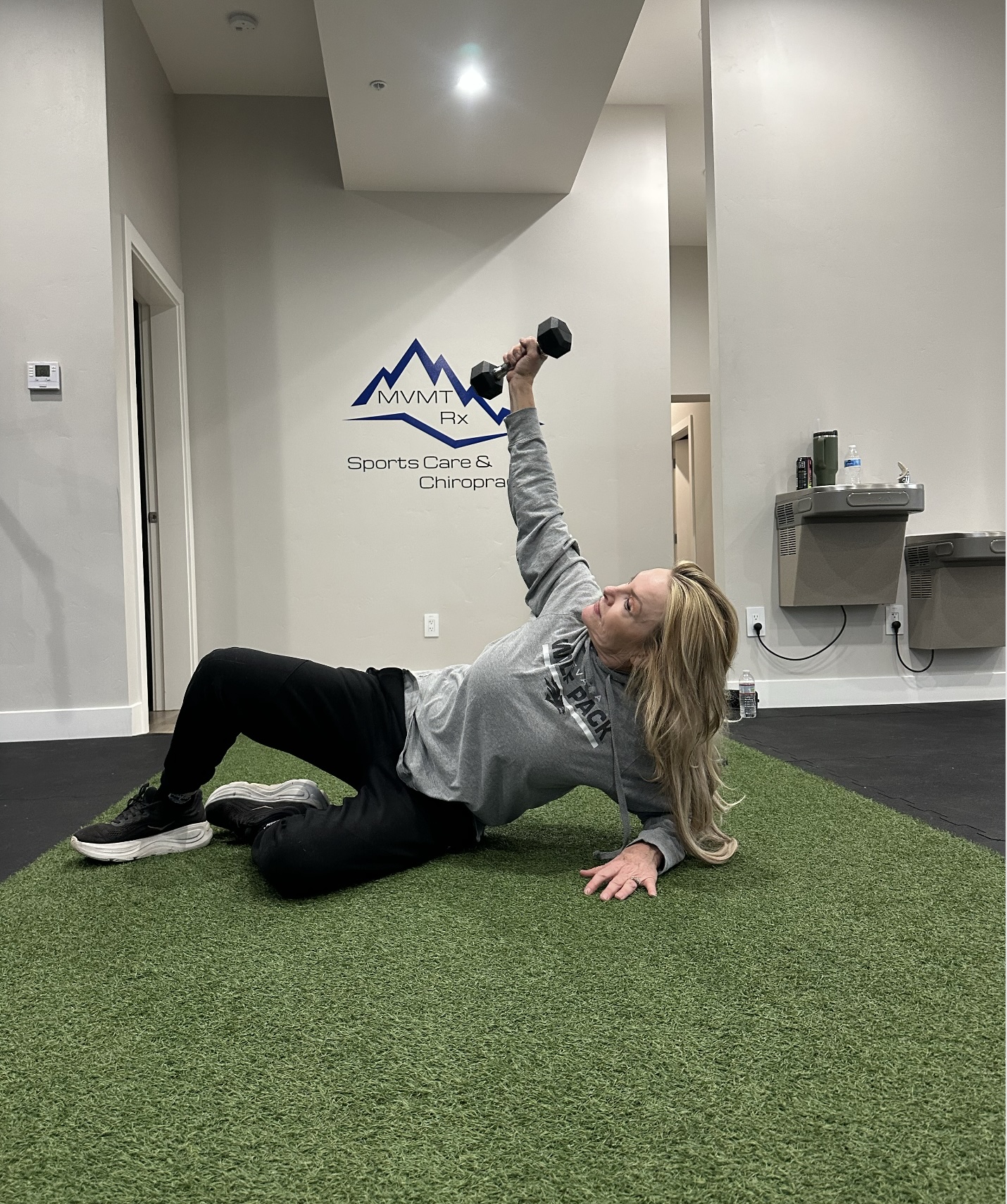
Lifespan — You graduate with the strength, the capacity, and the skillset to manage your shoulder long-term. You understand what your body needs, you know how to train it, and you have the confidence to push yourself without fear of pain or injury — whether you are pressing overhead in the gym, reaching into the back seat of your car, or catching yourself when life throws something unexpected at you.
The MRI does not define your ceiling. Your capacity does.
What This Looks Like
What a Shoulder Pain Plan Actually Looks Like at MVMT Rx
Every patient is different, but here is the general shape of how we approach persistent shoulder pain — the kind that has not responded to rest, generic PT, cortisone injections, or the "just avoid overhead" advice you have been following for too long.
Discovery Visit: A 60-minute, in-person assessment where we walk through your full history — including every provider you have seen, every treatment you have tried, and every activity you have given up because of the shoulder. We perform a functional evaluation of the entire upper body chain — not just the rotator cuff — and give you a clear picture of what is actually driving your pain. We test shoulder strength, scapular stability, thoracic mobility, and how your body moves under load. This is a root cause assessment, not a sales pitch. The goal is mutual confidence that you are in the right place and we can help.
Evaluation and First Treatment: If we both agree it is the right fit, we complete the clinical picture with additional assessment, then turn everything into a structured treatment session so you can experience firsthand what a high-intention, 60-minute session looks like — manual therapy, targeted loading, and clinical coaching in the same visit. From there, we make a clinical recommendation on a plan of care — including time, frequency, and investment — decided together.
Ongoing Care: Every session is 60 minutes, one-on-one with your doctor. Your plan adapts weekly based on how your shoulder responds — not based on a six-week protocol or insurance authorization. You receive programming to follow at home, at the gym, or on the road. You are coached, progressed, and held accountable through every phase. And you develop the movement literacy and body awareness to confidently manage your own shoulder for life.
What a shoulder pain plan at MVMT Rx may include: chiropractic adjustments to restore glenohumeral and thoracic joint mobility, Class IV laser for inflammation and pain management, myofascial release for rotator cuff and periscapular tissue quality, progressive rotator cuff strengthening from isometrics through heavy loaded work, scapular stability and upward rotation training, thoracic spine mobility restoration, posterior chain and lat strengthening for overhead mechanics, core stability training, progressive overhead loading and pressing, sport-specific or activity-specific training, objective retesting with dynamometer and limb symmetry index to track measurable progress, and ongoing plan adaptation based on your response.
Learn More: Performance Rehab at MVMT Rx →
How we use doctor-led, progressively loaded clinical rehabilitation to rebuild strength, capacity, and confidence for active adults in Reno and Sparks, NV.
Read the Full Guide: Why a Multi-Modal Approach Works →
Our complete breakdown of the RAIL System, our clinical toolkit, and why single-modality care fails for chronic pain.
Related: Knee Osteoarthritis — Why Generic Exercise Programs Fail →
The same doctor-led clinical rehab approach applied to knee osteoarthritis — why generic PT falls short and what objective testing changes.
Related: Why Your Low Back Pain Keeps Coming Back After Every Adjustment →
DNS, McKenzie-based assessment, and progressive loading — why adjustments alone fall short and what a multi-modal plan changes.
Related: Why Your Plantar Fasciitis Won't Go Away (And What Actually Works) →
Focused shockwave therapy, progressive loading, and clinical neurodynamics — why the stretch-ice-rest cycle fails for chronic heel pain.
Related: Neck Pain After Failed Chiropractic Care — What's Actually Going On →
Research shows 50% of shoulder pain has a cervical component. If your neck and shoulder both bother you, start here.
Related: Achilles Tendinitis — Why Rest and Stretching Are Making It Worse →
Focused shockwave therapy, progressive loading, and midfoot mobility — why rest and cortisone fail for chronic Achilles tendon pain.
Related: Hip Pain — Why Stretching and Foam Rolling Aren't Fixing Your Hips →
Clinical myofascial release, DNS, and progressive hip rehabilitation — why self-stretching fails for chronic hip pain.
Related: Herniated Disc — What Your MRI Isn't Telling You →
Class IV laser therapy, McKenzie assessment, neurodynamics, and progressive loading — why rest and fear make disc herniations worse.
Related: The Hidden Cost of Daily Tylenol and NSAIDs →
What the research says about daily OTC painkiller use — liver damage, GI bleeding, cardiovascular risk, delayed healing, and why your pain deserves a better answer than medication.
Frequently Asked Questions
Shoulder Pain & Clinical Rehab
My MRI shows a rotator cuff tear. Do I need surgery?
Not necessarily. The research shows that many rotator cuff tears — particularly partial tears and non-traumatic full-thickness tears — respond well to structured clinical rehab without surgery. Tears are also common in people with zero pain, especially as we age. The decision should be based on your functional limitations, how you respond to a well-designed rehab program, and your specific goals — not on the MRI alone. We will give you a clear clinical picture and an honest recommendation based on your individual situation.
I was told I have impingement. What does that actually mean?
Shoulder impingement has been one of the most overused diagnoses in musculoskeletal medicine. The traditional explanation — that a bone is pinching your tendon — has been largely challenged by current research. The surgery designed to fix it (subacromial decompression) has been shown to be no more effective than placebo. What is actually happening in most cases is that the shoulder lacks the strength, stability, and motor control to manage load in certain positions. The solution is not to avoid those positions. It is to build the capacity to handle them.
Should I avoid overhead movements if my shoulder hurts?
In most cases, the answer is no — not long-term. Short-term activity modification to calm the shoulder down is reasonable. But indefinite avoidance of overhead movement is one of the worst things you can do for a painful shoulder because the muscles and tendons that support overhead function weaken further without use. The goal of clinical rehab is to progressively rebuild the capacity to go overhead — safely, confidently, and under clinical supervision — so you can return to the activities you care about without restrictions.
How is this different from the PT I already tried?
Three things. First, every session is 60 minutes, one-on-one with your doctor — you are never handed off to an aide. Second, your program is built from objective strength and symmetry data and progresses based on measurable improvement — not a standard shoulder protocol or insurance timeline. Third, we do not stop at the rotator cuff. We assess and address the entire system — scapular stability, thoracic mobility, posterior chain strength, core stability — because the shoulder rarely fails in isolation.
How long does it take to fix shoulder pain with this approach?
Most patients see meaningful improvement in pain and function within the first four to six weeks as the shoulder calms down and capacity begins rebuilding. Full resolution — meaning you are back to all activities without symptoms and the shoulder has the strength and stability to stay that way — typically takes three to five months depending on how long the issue has been present, what is driving it, and what your goals are. Chronic cases with significant deconditioning may take longer because there is more capacity to rebuild.
Do you accept insurance?
MVMT Rx is a cash-pay practice. We provide superbills that you can submit to your insurance for potential reimbursement depending on your plan. We also offer in-house payment plans, CareCredit (no- and low-interest medical financing), and paid-in-full discounts for patients who are fully invested and ready to commit to the process.
References
- Yamamoto A, Takagishi K, Osawa T, et al. Prevalence and risk factors of a rotator cuff tear in the general population. Journal of Shoulder and Elbow Surgery. 2010;19(1):116–120. doi:10.1016/j.jse.2009.04.006
- Piper CC, Hughes AJ, Ma Y, et al. Operative versus nonoperative treatment for the management of full-thickness rotator cuff tears: a systematic review and meta-analysis. Journal of Shoulder and Elbow Surgery. 2018;27(3):572–576. doi:10.1016/j.jse.2017.09.032
- Beard DJ, Rees JL, Cook JA, et al. Arthroscopic subacromial decompression for subacromial shoulder pain (CSAW): a multicentre, pragmatic, parallel group, placebo-controlled, three-group, randomised surgical trial. The Lancet. 2018;391(10118):329–338. doi:10.1016/S0140-6736(17)32457-1
- Kuhn JE. Exercise in the treatment of rotator cuff impingement: a systematic review and a synthesized evidence-based rehabilitation protocol. Journal of Shoulder and Elbow Surgery. 2009;18(1):138–160. doi:10.1016/j.jse.2008.06.004
- Littlewood C, Ashton J, Chance-Larsen K, et al. Exercise for rotator cuff tendinopathy: a systematic review. Physiotherapy. 2012;98(2):101–109. doi:10.1016/j.physio.2011.08.002
- Coombes BK, Bisset L, Vicenzino B. Prevalence of cervical spine contribution in patients presenting with shoulder pain: an observational study. Musculoskeletal Science and Practice. 2024;73:103092. doi:10.1016/j.msksp.2024.103092
- Katsuura Y, Morales TN, Otsuka NY, et al. The prevalence of concurrent cervical pathology in patients with shoulder pain: a systematic review. Global Spine Journal. 2020;10(8):1080–1091. doi:10.1177/2192568218822536
Done Living Around Your Shoulder?
If rest, generic PT, and cortisone have not fixed your shoulder — the problem is not your commitment. It is the approach. Start with a free conversation.
Book Your Free Discovery CallMVMT Rx Sports Care & Chiropractic | Reno & Sparks, NV | (775) 245-4142


Free Guides
Patient Care
Links
© Copyright 2026. MVMT Rx Sports Care & Chiropractic. All Rights Reserved.