Shockwave Therapy in Reno and Sparks, NV
Focused Shockwave Therapy in Reno — Advanced Treatment for Chronic Tendon and Soft Tissue Pain
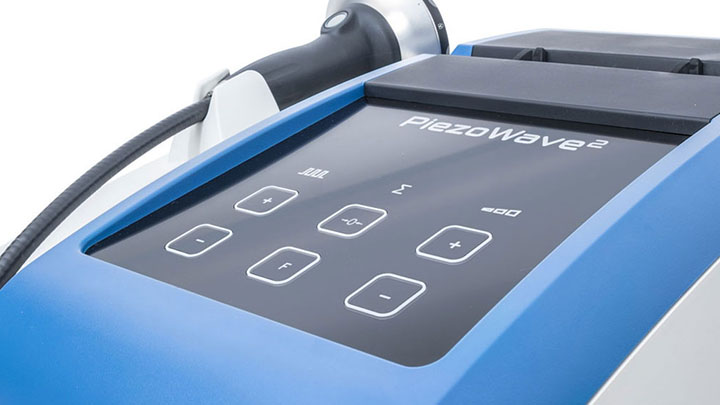
PiezoWave 2 focused shockwave — precise, deep-tissue treatment for tendon problems and soft tissue injuries that refuse to heal. Integrated into a real plan, never used alone.
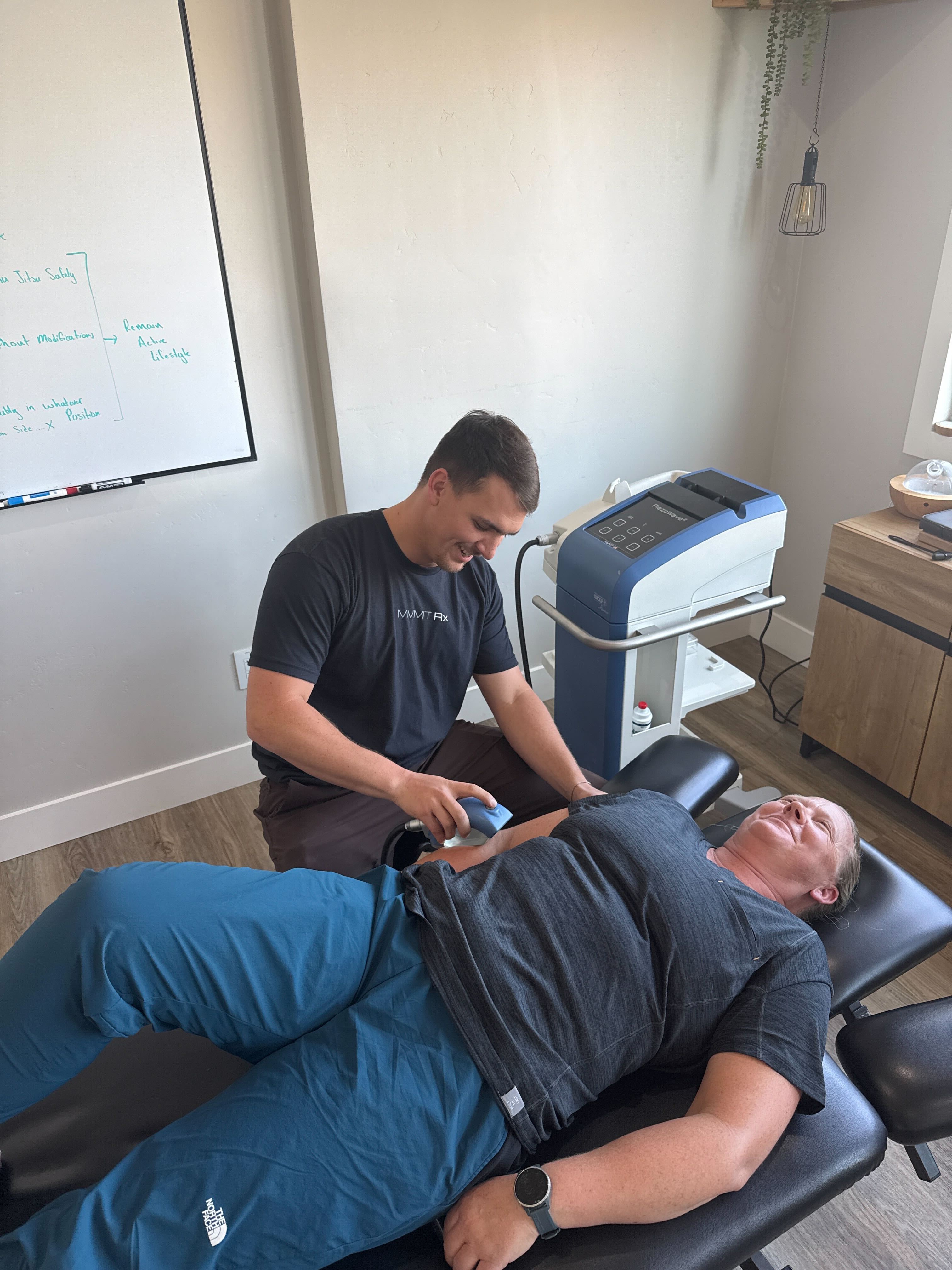
Some problems refuse to respond to conventional treatment. You have done the stretching, the icing, the rest, maybe even the injections — and the tendonitis, the chronic tightness, or the stubborn soft tissue issue is still there. Sometimes the tissue itself needs a different kind of stimulus to restart the healing process.
That is where focused shockwave therapy comes in.
At MVMT Rx, we use the PiezoWave 2 — a focused acoustic wave device that delivers precise, controlled energy to damaged or degenerative tissue. Unlike radial shockwave devices (the ones you will find at most clinics), focused shockwave reaches deeper tissue layers with greater precision, making it significantly more effective for chronic conditions that have failed to respond to standard care.
And like everything we do, shockwave is delivered during a 60-minute one-on-one session with your doctor in Reno. It is never the only thing we do. It is one tool integrated into a comprehensive plan designed to solve your problem — not just manage it.
The Science Behind It
How Focused Shockwave Therapy Works
Think of it this way: imagine a pothole on a road that the city keeps ignoring. Traffic cones go up, people drive around it, but nobody ever actually fixes it. Your chronic tendonitis is that pothole. Your body has been routing around the damage for months — maybe years — but never sent a real repair crew to fix it. Shockwave therapy forces your body to send the crew. It delivers a controlled pulse of energy into the damaged tissue that tells your body: stop ignoring this, send resources, and fix it.
That is the simple version. Here is the science behind it.
New Blood Vessel Formation
Chronic tendonitis and tendinopathy are often characterized by poor blood supply — the tissue literally does not have the resources to heal. Shockwave stimulates the formation of new blood vessels in the treatment area, bringing the oxygen and nutrients the tissue needs to actually repair itself.
Cellular Repair Activation
The acoustic waves kick-start your body’s natural repair mechanisms — increasing growth factor production, stem cell recruitment, and collagen synthesis in the targeted tissue. This is not masking pain. It is stimulating actual tissue healing and regeneration.
Pain Modulation
Shockwave disrupts pain signaling pathways and reduces the chemical messengers associated with chronic pain in the treated area. Patients frequently report significant pain reduction after just a few sessions, and this reduction tends to hold because it is accompanied by real tissue changes — not just a temporary analgesic effect.
The Technology Difference
Why We Use the PiezoWave 2 — Not Radial Shockwave
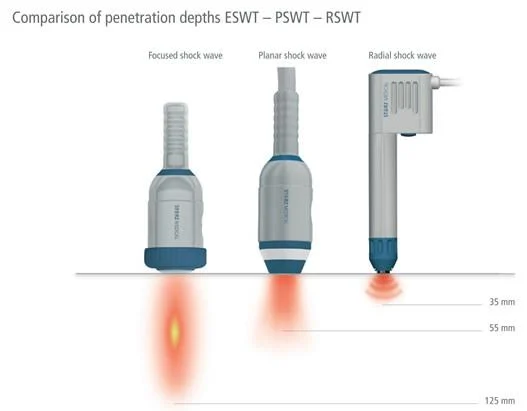
Not all shockwave devices are the same. Most clinics offering shockwave therapy use radial pressure wave devices that disperse energy broadly across the surface. The energy dissipates as it travels deeper, which means the therapeutic dose reaching your damaged tissue is significantly lower.
Focused precision at depth
The PiezoWave 2 uses focused piezoelectric technology. The energy converges at a specific depth and location — meaning we target the exact tissue that needs treatment with the full therapeutic dose.
Reaches where radial devices cannot
Most chronic tendon and soft tissue problems live at specific depths that radial devices simply cannot reach with adequate intensity. The PiezoWave 2 delivers the full dose where it matters.
Not a marketing difference — a physics difference
This translates directly into clinical results: faster response, fewer sessions needed, and better outcomes for deep or chronic tissue problems.
What It Treats
Conditions Shockwave Therapy Treats
Focused shockwave therapy at MVMT Rx is most commonly used for patients in Reno and Sparks dealing with:
Chronic Tendonitis and Tendinopathy
Achilles tendonitis, patellar tendonitis (jumper’s knee), rotator cuff tendinopathy, lateral epicondylitis (tennis elbow), and medial epicondylitis (golfer’s elbow). Tendinopathy is the updated clinical term, but the bottom line is the same: degenerative changes in the tendon that do not respond well to rest, stretching, or anti-inflammatories alone. Shockwave addresses the tissue degeneration directly.
Plantar Fasciitis and Heel Pain
One of the most well-researched applications of shockwave therapy. When plantar fasciitis becomes chronic — lasting months or longer despite conservative treatment — focused shockwave is one of the most effective non-surgical interventions available.
Calcific Tendinopathy
Calcium deposits in tendons — particularly the shoulder — can cause severe pain and movement restriction. Focused shockwave can break down calcific deposits and stimulate their reabsorption, often avoiding the need for surgical removal.
Chronic Myofascial Trigger Points
Stubborn trigger points that do not respond to manual therapy, dry needling, or other soft tissue techniques can respond well to focused shockwave, which disrupts the trigger point and stimulates tissue remodeling.
Chronic Soft Tissue Injuries in Active Adults
Our patients over 50 frequently present with tissue that has been dealing with low-grade damage and degeneration for years — often from staying active through discomfort without ever getting the tissue the stimulus it needs to repair. Shockwave can restart that stalled healing process.
Inside the Session
What Shockwave Therapy Looks Like at MVMT Rx
Shockwave is never the only thing that happens during your visit. A typical session that includes shockwave involves assessment and objective testing to track your progress, targeted shockwave application to the affected tissue (usually 5–10 minutes of actual shockwave delivery), followed by manual therapy, mobility work, or rehab exercises designed to take advantage of the pain reduction and tissue response created by the shockwave.
This sequencing matters. Shockwave creates a window — reduced pain, improved blood flow, activated healing — and the rehab that follows capitalizes on that window. Clinics that deliver shockwave in a 10-minute appointment and send you home are leaving most of the benefit on the table.
Why this matters for your RAIL progression
When shockwave is combined with our rehab programming, patients get to Phase 3 of our RAIL System — Integration — faster and with less pain. Phase 3 is where the real progress happens: developing true strength, power, and the kind of robustness that makes your body hard to break down. The more time you spend in Integration rather than fighting through pain and early-stage recovery, the stronger and more resilient you come out the other side. Shockwave helps us get you there quicker and keep you there longer.
Most patients see meaningful improvement within 3–6 sessions, depending on the chronicity and severity of the condition. We track your response with objective measures — not just how does it feel — so we know whether the tissue is actually changing.
Is It Right for You
Who Shockwave Therapy Is For — and Who It Is Not For
Shockwave is not a first-line treatment for every patient. We recommend it when your tendonitis or tendinopathy is chronic — typically lasting 3 or more months — and has not responded adequately to manual therapy, exercise, and standard conservative care.
You have a specific tendon or soft tissue pathology that is supported by the research on shockwave effectiveness. And you are willing to combine shockwave with the rehab and loading work required to maintain and build on the tissue improvements.
Shockwave is not for patients looking for a passive fix. It is a powerful stimulus, but without the rehab, loading, and progressive capacity building that follows, the results will plateau. We are always transparent about this upfront.
Patient Reviews
What Patients Say About Shockwave Treatment at MVMT Rx
Real reviews from patients in Reno and Sparks whose treatment included focused shockwave therapy.
Common Questions
Frequently Asked Questions About Shockwave Therapy
Does shockwave therapy hurt?
Most patients describe the sensation as a deep tapping or pulsing. Some areas — particularly chronic, inflamed tendons — can be sensitive during treatment, but the intensity is always adjustable. The treatment itself typically takes 5–10 minutes, and any discomfort during the session is temporary. Most patients tolerate it well and report feeling better after treatment.
How many shockwave sessions do I need?
Most patients see meaningful improvement within 3–6 sessions, depending on the chronicity and severity of the condition. Shockwave at MVMT Rx is always integrated into a comprehensive treatment plan — so your total number of sessions depends on your specific condition and how it responds to the combination of shockwave, rehab, and loading work.
What is the difference between focused and radial shockwave?
Radial shockwave devices disperse energy broadly across the surface, with the energy dissipating as it travels deeper. Focused shockwave (like the PiezoWave 2 we use at MVMT Rx) converges energy at a specific depth and location, delivering the full therapeutic dose directly to the damaged tissue. This is especially important for chronic tendon and deep soft tissue problems that radial devices cannot reach with adequate intensity.
Is shockwave therapy covered by insurance?
MVMT Rx is a cash-pay practice. Shockwave therapy is part of your comprehensive treatment plan and is included in your 60-minute one-on-one sessions with the doctor. We do not bill insurance, but many patients find that our results-focused approach saves them time and money compared to months of conventional treatment that only provides temporary relief.
Take the Next Step
Dealing with Tendonitis, Tendinopathy, or a Soft Tissue Problem That Will Not Go Away?
Book a free Discovery Call. We will talk about what you have tried, whether focused shockwave therapy could help, and what a real plan to resolve the issue looks like.


Free Guides
Patient Care
Links
© Copyright 2026. MVMT Rx Sports Care & Chiropractic. All Rights Reserved.